

When interest rates stop rising, many investors expect an immediate surge in property prices. While this can happen, the reality is more nuanced. The pause in rate hikes often marks a turning point in market sentiment, but the actual impact on property markets depends on timing, confidence, and underlying supply and demand.
Understanding what typically happens during this phase can help investors position themselves ahead of the next cycle.
The Shift From Uncertainty to Stability
When rates are increasing, uncertainty dominates the market. Buyers hesitate, borrowing capacity shrinks, and sentiment weakens. However, once rates stabilize, even at higher levels, the uncertainty begins to ease.
This shift is critical. Buyers and investors can now make decisions with more confidence, knowing that borrowing costs are no longer rapidly changing. Rate movements are designed to manage inflation over time, and periods of stability often follow tightening cycles.
Borrowing Power Stops Falling
During rate hikes, borrowing capacity declines with each increase. Once rates stop rising, this downward pressure stabilises. While borrowing power doesn’t immediately improve, the key change is that it stops getting worse.
This creates a more predictable environment for both buyers and lenders. Investors who were previously sidelined may start re-entering the market as confidence improves.
Buyer Confidence Begins to Return
Confidence is one of the biggest drivers of property markets. When rates stop rising, buyers begin to feel that the worst of the tightening cycle may be over.
This doesn’t mean an instant boom, but it often leads to:
- Increased enquiry levels
- More competition at auctions
- Gradual improvement in transaction volumes
This shift in sentiment is often the early stage of the next growth phase.
Prices Often Stabilise Before They Rise
Historically, property markets tend to stabilise once interest rates stop rising, rather than immediately surge. This is because the market needs time to absorb previous rate increases.
Over time, as confidence improves and demand returns, price growth can follow. This reinforces the idea that property markets move in cycles, not instant reactions. This transition phase is explored further in our analysis, where markets typically move through a period of stabilisation before the next growth cycle begins.
Property Market Stabilisation After Interest Rate Hikes
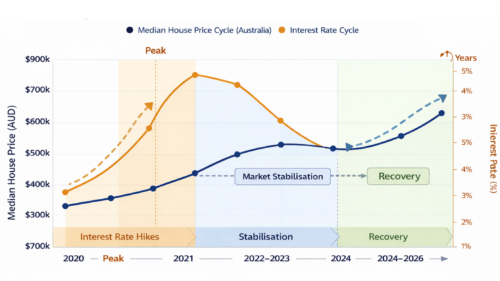
This graph shows how property prices typically slow and stabilise after interest rate hikes. Rather than falling immediately, the market enters a transition phase before moving into recovery. It highlights that property markets adjust gradually, not instantly, following changes in interest rates.
Supply and Demand Still Drive the Market
Even when rates stabilize, the fundamental drivers of the market remain unchanged. Population growth, housing shortages, and rental demand continue to influence property prices.
In Australia, limited housing supply has been a key factor supporting prices, even during periods of higher interest rates. When demand remains strong and supply is constrained, property values are less likely to decline significantly.
Investors Start Positioning Early
Experienced investors often act before the market fully recovers. When rates stop rising, they recognise it as a signal that conditions may soon improve.
Rather than waiting for clear price growth, they:
- Enter the market during stabilisation
- Take advantage of reduced competition
- Position for the next growth phase
Frequently Asked Questions (FAQ)
- Do property prices rise immediately when interest rates stop increasing?
Not always. Prices typically stabilise first before any significant growth occurs. - Is a rate pause a good time to invest?
It can be, as it often signals improving conditions and reduced uncertainty. - Will borrowing power improve when rates stop rising?
It stabilises first, and may improve later if rates begin to fall. - What happens to demand when rates stabilise?
Demand often gradually increases as buyer confidence returns. - Should investors wait for rates to fall before buying?
Waiting may mean facing more competition and higher prices. Many investors act during the stabilisation phase instead.
What This Means for Property Investors
The pause in interest rate increases is often a transition phase, not the final outcome. It signals that the market may be moving from contraction toward recovery.
For investors, this period can present opportunities to enter the market before competition intensifies.
At Citadel Agency, we help investors understand where the market sits within the cycle so they can make informed, strategic decisions. If you’re planning your next move, you can connect with our team. You can also access more insights through our property investment guidance hub.