

Investing in property is not only about choosing the right suburb or timing the market. One of the most overlooked decisions is how the property is legally owned from the beginning. The ownership structure you choose will influence how your income is taxed, how well your assets are protected, and how easily you can scale your portfolio over time. Getting this right early can prevent costly restructuring later.
Why Ownership Structure Matters
The structure you select determines how rental income is treated, who benefits from deductions, and how exposed you are to financial or legal risk. The Australian Taxation Office explains in its guidance on investment properties that ownership directly affects tax obligations, including how income and capital gains are assessed. This means two investors holding identical properties may end up with very different after-tax outcomes simply because of how ownership is structured.
Individual Ownership
Holding a property in your own name is the simplest approach. It’s commonly chosen by first-time investors for its ease of setup and management. Income and expenses are straightforward to report, and you keep all profits (or losses). Negative gearing works directly against your personal income, potentially reducing your tax bill. The downside is twofold: first, taxes, all rent is taxed at your marginal rate, so if you’re in a high bracket you pay more tax on investment gains. Second, risk, you have no built-in asset protection. If something goes wrong (like a legal claim or debts), your personal assets could be exposed. Also, individual ownership offers little flexibility for splitting income with a spouse or family member who might be in a lower tax bracket.
Joint Ownership
Joint ownership involves two or more individuals sharing the property, either equally or in defined proportions. This structure is commonly used by couples or family members. It allows income and expenses to be split according to ownership percentages, which can create opportunities for tax planning when incomes differ. However, it can also introduce complexity if disagreements arise, and decision-making is no longer solely controlled by one party.
Trust Structure
A trust structure involves holding the property on behalf of beneficiaries, typically managed by a trustee. This approach is often used by more experienced investors who are focused on long-term planning and asset protection. According to housing market data analyses, higher-income families often use trusts or companies to manage property income effectively. Trusts also offer a degree of protection: if set up properly, creditors of a beneficiary cannot usually claim trust assets. This can safeguard the property if a beneficiary faces legal or financial trouble. Trusts shine in estate planning too – a trust can continue beyond an individual’s lifetime, easing the transfer of wealth to the next generation without the delays of probate.
Company Ownership
Owning property through a company means the asset is held by a separate legal entity. This structure provides a level of liability protection and operates under a fixed corporate tax rate. However, it lacks some of the tax advantages available to individual investors, such as the capital gains tax discount. It is typically considered by investors who are focused on building larger portfolios or integrating property into broader business strategies.
Comparison of Ownership Structures
|
Structure |
Tax Flexibility | Asset Protection | Complexity |
Best For |
|
Individual |
Low – taxed at personal rate | Low – direct personal liability | Low – simplest to set up |
First-time or part-time investors |
|
Joint |
Medium – split by ownership shares | Low – shared liability | Low – need co-owner agreement |
Couples or family co-investors |
|
Trust |
High – income can be distributed flexibly | High – strong protection if structured properly | High – setup and compliance costs |
Established investors building a family portfolio |
|
Company |
Medium – fixed 30% tax rate, no CGT discount | High – limited liability | High – corporate requirements |
Investors scaling up, syndicates, or developers |
Figure: The total estimated value of Australian residential dwellings rose steadily over 2021–2025 (increasing from about $7.8 trillion to $12.3 trillion), reflecting strong price growth and new construction. This underscores why structuring ownership to optimise tax and growth is so important.
Investment Growth vs Structure Strategy
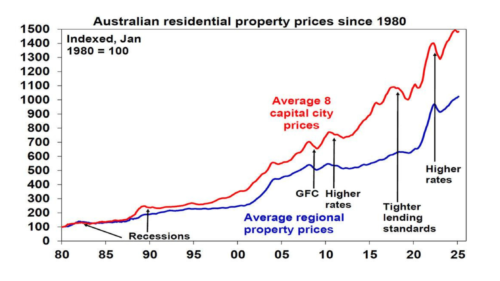
While market performance is influenced by broader factors like interest rates and supply, structure plays a behind-the-scenes role in how much of that growth you actually retain.
Key Factors to Consider Early
When deciding on an ownership structure, investors need to think beyond the immediate purchase and consider their long-term strategy. Someone planning to build a multi-property portfolio may benefit from a structure that allows flexibility and scalability, while a single-property investor may prioritise simplicity. Borrowing capacity is another critical factor, as lending policies differ depending on whether the borrower is an individual, trust, or company. Insights from the Reserve Bank of Australia highlight how lending conditions and interest rate changes influence investor borrowing power, making structure an important part of financial planning. Risk exposure should also be assessed, particularly for individuals in professions with higher legal liability, where asset protection becomes more relevant.
Frequently Asked Questions (FAQ)
- What is the best ownership structure for property investment in Australia?
The best structure depends on your financial situation, income level, and long-term goals. Individual ownership is simple, while trusts and companies offer more flexibility and protection for more advanced strategies. - Can I change my property ownership structure later?
Yes, but changing ownership can trigger taxes such as capital gains tax and stamp duty, which may make restructuring expensive. - Do trusts reduce property tax?
Trusts can help distribute income more efficiently, but they do not automatically reduce tax. The benefit depends on how income is allocated among beneficiaries. - Does ownership structure affect borrowing capacity?
Yes, lenders assess borrowing differently depending on the structure, and this can influence how much you can borrow. - Is joint ownership better for couples?
Joint ownership can be beneficial for couples, especially when incomes differ, as it allows for shared responsibility and potential tax planning advantages.
Getting It Right From the Start
Restructuring ownership after purchase can trigger significant costs, including stamp duty and capital gains tax, which can erode investment returns. Establishing the right structure early helps avoid these issues and ensures your strategy is aligned with your financial goals from day one. Working with professionals can provide clarity on how to balance tax efficiency, protection, and growth potential.
If you’re planning your next investment, you can connect with our team and explore more insights via our property strategy resources.