
For many years, Australian property investors focused primarily on capital growth. The goal was to buy in a strong market, hold the property, and benefit from rising values over time. While capital growth remains an important part of long-term wealth creation, the current market is prompting many investors to place greater emphasis on cash flow.
Higher interest rates, increased holding costs, and tighter lending conditions have made serviceability more important than ever. Investors are becoming more focused on whether a property can support itself financially rather than relying solely on future price appreciation.
In 2026, this shift is changing how investors assess opportunities. Properties with stronger rental yields and better cash flow are attracting more attention, particularly in markets where borrowing costs remain elevated.
Why Cash Flow Matters More in 2026
Interest rates have significantly increased mortgage repayments, making negatively geared properties more expensive to hold. Investors who once tolerated short-term losses in exchange for expected capital growth are becoming more cautious.
At the same time, rising expenses such as insurance, maintenance, council rates, and property management fees are adding further pressure to holding costs. Properties that generate stronger rental income are therefore becoming more attractive because they help reduce out-of-pocket costs.
This change is encouraging investors to focus on financial sustainability. A property that can be comfortably held through varying market conditions is often more valuable than one that relies entirely on future growth.
Capital Growth Still Matters
Cash flow is becoming more important, but this does not mean capital growth is no longer relevant. Long-term wealth creation is still driven by the ability of a property to appreciate over time.
The key difference is that investors are increasingly seeking properties that offer a balance between both outcomes. Strong rental performance helps support holding costs, while solid market fundamentals create the potential for future growth.
Properties that combine healthy cash flow with quality growth drivers can provide both short-term stability and long-term wealth creation. This approach allows investors to hold their assets more comfortably through changing market conditions while still benefiting from future capital appreciation.
Rather than choosing between cash flow and growth, many successful investors focus on finding opportunities that deliver both. When rental income supports the property and the location has strong underlying fundamentals, investors are better positioned to build a resilient and sustainable portfolio over time.
Higher Yields Improve Flexibility
Properties with stronger cash flow provide investors with greater flexibility. Positive or neutral cash flow can reduce financial stress, improve borrowing capacity over time, and allow investors to hold assets more confidently during market fluctuations.
Stronger cash flow can also create opportunities to save for future deposits, renovate existing properties, or build financial buffers. This makes it easier to expand a portfolio without becoming overextended.
In uncertain markets, flexibility is a significant advantage. Investors who maintain healthy cash flow are often better positioned to take advantage of emerging opportunities.
Investor Priorities Are Changing
As borrowing costs remain elevated, many investors are reassessing what makes a property truly valuable. Rather than focusing only on projected capital gains, they are paying closer attention to rental demand, vacancy rates, and net holding costs.
This reflects a more disciplined approach to investing. Sustainable cash flow allows investors to hold quality properties for longer, which is often the key to capturing long-term growth.
Cash Flow vs Capital Growth (2020-2026)
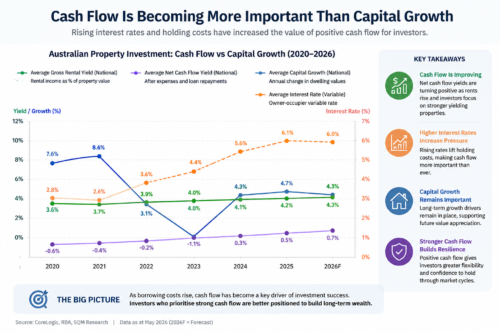
This graph illustrates how cash flow has become a more important consideration for property investors as interest rates and holding costs have increased.
While capital growth remains essential for long-term wealth creation, stronger cash flow is helping investors maintain financial flexibility and hold their properties with greater confidence
Frequently Asked Questions (FAQ)
- Is cash flow more important than capital growth?
Both are important, but higher interest rates are making cash flow increasingly critical for managing holding costs. - Can a property deliver both cash flow and growth?
Yes. Many investors seek markets that offer solid rental yields and strong long-term fundamentals. - Why is cash flow so important now?
Rising interest rates and higher expenses have increased the cost of holding investment properties. - Does capital growth still matter?
Absolutely. Capital growth remains a core driver of long-term wealth creation. - What should investors prioritise in 2026?
Financial sustainability, rental demand, and strong local market fundamentals.
What This Means for Property Investors
The best opportunities in 2026 are often properties that combine sustainable cash flow with strong long-term growth potential. Investors no longer need to choose one or the other, but they do need to understand how both factors affect portfolio performance.
A property that is difficult to hold can create financial pressure, regardless of its future growth prospects. By prioritising cash flow, investors can improve resilience while still positioning themselves for capital appreciation.
At Citadel Agency, we help investors identify properties that balance cash flow, growth potential, and long-term strategic value. Explore our property strategy resources for more expert insights.
If you’d like tailored guidance based on your investment goals, contact our team for personalized support.