
Australia’s property market in 2026 is increasingly being described as a “two-speed” market. While some suburbs and cities continue recording strong price growth, others are showing much slower performance or even stagnation.
This divergence reflects the fact that the Australian housing market is not moving as one uniform market. Instead, different locations and property segments are responding in very different ways to affordability pressures, population growth, supply constraints, and changing buyer preferences.
For investors, understanding which markets are outperforming and which are underperforming is becoming more important than ever.
What Is a Two-Speed Property Market?
A two-speed property market occurs when certain parts of the market grow strongly while others lag behind. This can happen between cities, regions, suburbs, or even different property types within the same location.
For example, affordable suburbs with strong rental demand may continue recording price growth, while premium markets facing affordability challenges may experience slower performance. Similarly, markets with tight housing supply can outperform areas where supply is more balanced.
This divergence means investors need to focus on local market fundamentals rather than relying solely on national averages.
Why Some Markets Are Outperforming
Outperforming markets generally share several common characteristics. They tend to have strong population growth, limited housing supply, tight rental conditions, and relatively affordable entry points.
These factors create sustained demand and support both rental growth and price performance. Markets that attract owner-occupiers, investors, and migrants often demonstrate greater resilience during uncertain economic conditions.
Locations with major infrastructure investment and employment growth can also benefit from stronger long-term demand.
Why Some Markets Are Underperforming
Underperforming markets often face one or more limiting factors. These may include affordability constraints, weaker population growth, oversupply, or reduced buyer demand.
Premium suburbs are particularly vulnerable when borrowing capacity declines because they rely on a smaller pool of buyers. Markets with high levels of new construction can also experience softer conditions if supply exceeds demand.
This does not mean these areas will decline permanently, but they may grow more slowly than stronger-performing markets.
What the Data Shows
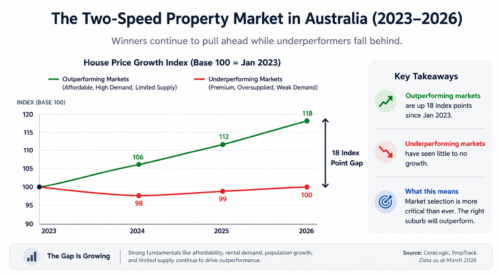
This graph illustrates the growing gap between outperforming and underperforming property markets in Australia during 2026.
Affordable suburbs with strong demand and limited supply are continuing to post stronger growth, while premium and oversupplied markets are showing slower performance. The data highlights why market selection is becoming increasingly important for investors.
National Headlines Can Be Misleading
One of the biggest challenges for investors is that national averages often hide large differences between individual markets.
A modest national growth rate may include some suburbs rising strongly while others remain flat. Investors who rely solely on broad market commentary may miss opportunities in locations with stronger fundamentals.
Frequently Asked Questions (FAQ)
- What is a two-speed property market?
It describes a market where some locations are growing strongly while others are underperforming. - Why are affordable suburbs outperforming?
They attract a larger buyer pool, stronger rental demand, and greater affordability. - Are premium suburbs underperforming?
Some are experiencing slower growth due to affordability constraints and reduced buyer demand. - Should investors avoid underperforming markets?
Not always, but they may offer weaker short-term growth compared to stronger-performing locations. - What matters most in 2026?
Local supply-demand fundamentals and careful market selection.
What This Means for Property Investors
The key lesson of a two-speed property market is that not all properties will perform equally. Market selection matters more than ever.
Investors who focus on affordability, rental demand, population growth, and supply constraints are more likely to identify high-performing opportunities. Meanwhile, markets facing affordability limits or oversupply may continue to lag.
At Citadel Agency, we help investors identify high-performing markets using data-driven analysis and long-term strategy. If you want guidance on where the strongest opportunities may be in the current market, you can connect with our team. You can also access more insights through our property investment guidance hub.