
In this article 8 sections
Capital growth is the increase in a property’s value over time. To calculate it, subtract the purchase price from the current value, divide by the purchase price and multiply by 100. To compare properties, convert that into an average yearly rate. Here are both formulas, worked examples, and how to estimate a future value on assumptions you choose.
What is capital growth in property?
Capital growth is the increase in a property’s value over time. If you buy for $500,000 and the property is later worth $650,000, it has grown by $150,000. Growth is on paper until you sell, and values can fall as well as rise.
How do you calculate capital growth?
Use this formula for total growth:
Capital growth % = (current value minus purchase price) ÷ purchase price × 100
Example: bought for $500,000, worth $650,000 six years later. ($650,000 minus $500,000) ÷ $500,000 × 100 = 30% total growth.
How do you calculate annual capital growth?
Total growth hides how long it took. To compare properties, work out the average yearly (compound) rate:
Annual growth = (current value ÷ purchase price) to the power of (1 ÷ years), minus 1
Same example: ($650,000 ÷ $500,000) to the power of 1/6, minus 1 = about 4.5% a year. Most calculators, including ours, do this step for you.
How do you estimate what a property could be worth?
Run the formula forwards: future value = value today × (1 + yearly rate) to the power of years.
At an assumed 4% a year, a $600,000 property would be worth about $888,000 after 10 years. That is an assumption, not a forecast. Try low, middle and high rates to see the range.
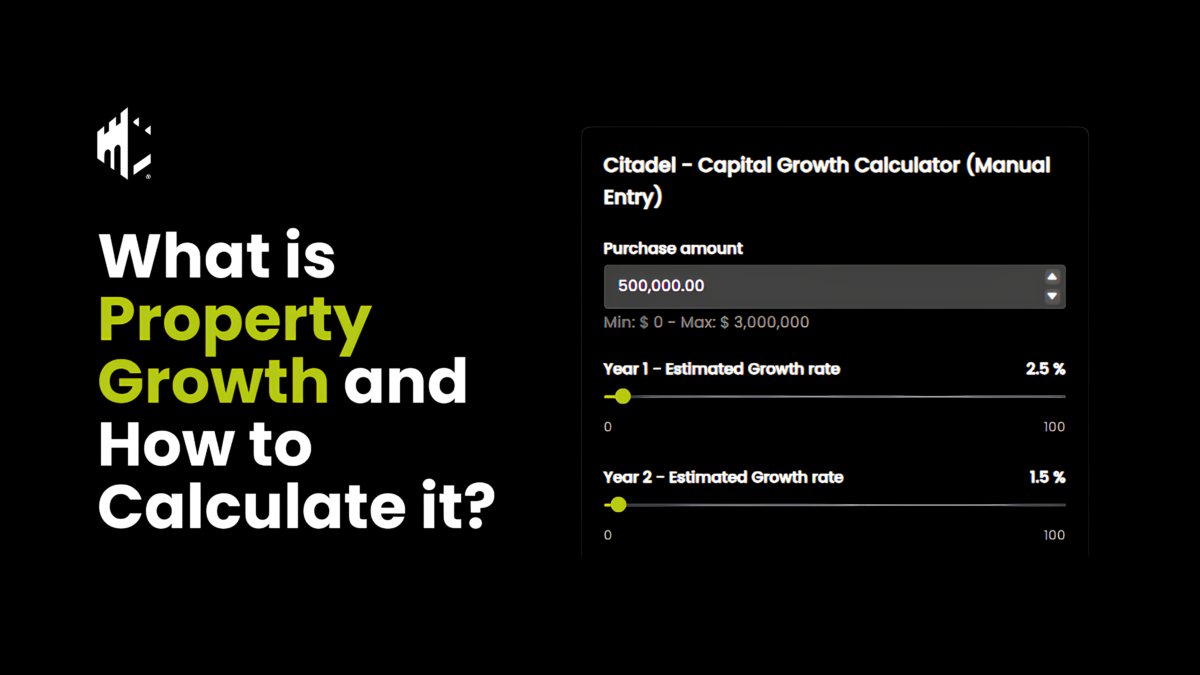
Try the property growth calculator →
What drives capital growth?
- Land: the land usually holds and grows value, while buildings age.
- Supply: how many similar homes are being built or listed nearby.
- Demand: population, jobs and incomes in the area.
- Infrastructure: transport, schools and hospitals that make an area easier to live in.
- Condition and improvements: work that adds value, such as a renovation. See our Kings Meadows case study.
Past growth does not guarantee future growth. Use it to understand an area, not to predict it.
Capital growth or rental yield: which matters more?
Both. Growth builds wealth over time, while yield, the rent as a percentage of the price, pays the holding costs along the way. A property with strong growth but low rent can be expensive to hold. Check both before you buy.
Is capital growth taxed?
Capital gains tax applies when you sell an investment property for more than its cost base. The rules change from 1 July 2027: for individuals, gains that build up from that date use cost base indexation instead of the 50% discount, with a 30% minimum tax on certain gains, and gains before then keep the 50% discount. Investors in new builds can choose to keep the 50% discount. See the ATO and speak to a registered tax agent.
Capital growth FAQ
How do I calculate capital growth on a property?
Subtract the purchase price from the current value, divide by the purchase price and multiply by 100. $500,000 to $650,000 is 30% total growth.
How do I work out annual capital growth?
Divide the current value by the purchase price, raise it to the power of 1 divided by the number of years, and subtract 1. $500,000 to $650,000 over 6 years is about 4.5% a year.
What is a good capital growth rate?
There is no set number. Compare a property with similar homes in the same area over the same period, and remember past growth does not guarantee future growth.
Is capital growth the same as equity?
No. Equity is the value of the property minus what you owe on it. Growth increases your equity, and so does paying down the loan.
Do I pay tax on capital growth?
Only when you sell, through capital gains tax. The rules change from 1 July 2027, so check with a registered tax agent.
Sources: ATO, Reforming negative gearing and capital gains tax; Moneysmart, Buying an investment property.
General information only. It does not take your objectives, financial situation or needs into account and is not financial, tax or legal advice.
General information only. It does not take your objectives, financial situation or needs into account and is not financial, tax, credit or legal advice.