
For years, property investors have debated whether it is better to focus on high rental yields or strong capital growth. Both strategies can be effective, but changing market conditions in 2026 are reshaping how investors evaluate opportunities.
Higher interest rates, rising holding costs, and ongoing affordability pressures have increased the importance of cash flow. At the same time, long-term wealth creation still depends heavily on capital growth. As a result, investors are increasingly looking beyond simple yield or growth metrics and focusing on how each strategy aligns with their goals.
The question is no longer which strategy is universally better, but which approach is performing best in the current market environment.
Understanding High-Yield Investing
High-yield properties generate stronger rental income relative to their purchase price. These properties are often located in affordable suburbs, regional markets, or areas with particularly strong rental demand.
The main advantage of a high-yield strategy is improved cash flow. Strong rental income can help offset mortgage repayments, reduce holding costs, and improve financial flexibility.
In a higher-rate environment, this additional income has become increasingly attractive to investors seeking greater portfolio stability.
Understanding High-Growth Investing
High-growth properties are purchased primarily for their potential to increase in value over time. These properties are often located in areas with strong population growth, limited supply, infrastructure investment, and long-term economic drivers.
The benefit of this strategy is wealth creation through capital appreciation. While rental yields may be lower, significant growth can generate substantial equity gains over the long term.
Historically, many of Australia’s strongest-performing property markets have delivered their greatest returns through capital growth rather than rental income alone.
Why High-Yield Strategies Are Gaining Attention
The current interest rate environment has increased investor focus on cash flow. Rising borrowing costs mean many investors are paying closer attention to whether a property can support itself financially. Rather than relying solely on future capital growth, investors are increasingly assessing how much rental income a property can generate today and whether that income can help offset higher mortgage repayments.
Strong rental demand, low vacancy rates, and rising rents have improved yields in many affordable markets. This has made high-yield properties more attractive than they were during periods of ultra-low interest rates. In many locations, rental income has increased significantly over the past few years, helping investors manage rising holding costs while maintaining stronger cash flow positions.
Why Growth Still Matters
Despite the growing focus on yield, capital growth remains one of the most important drivers of long-term wealth creation. Rental income helps support a property, but equity growth often creates the largest financial gains over time.
Markets with strong fundamentals such as population growth, infrastructure spending, and limited housing supply continue to offer attractive long-term growth prospects.
This means investors should be cautious about chasing yield alone. A property with strong rental returns but limited growth potential may not deliver the same long-term outcomes as a balanced investment.
The Most Successful Investors Are Blending Both
Rather than choosing one strategy exclusively, many investors in 2026 are seeking a balance between yield and growth. They are targeting properties that offer sustainable rental income while also being located in areas with strong future growth drivers.
This approach can provide both short-term financial resilience and long-term wealth creation. Strong cash flow supports holding costs, while capital growth builds equity over time.
For many investors, the winning strategy in 2026 is not yield versus growth, it’s finding opportunities that deliver both.
High-Yield vs High-Growth Performance
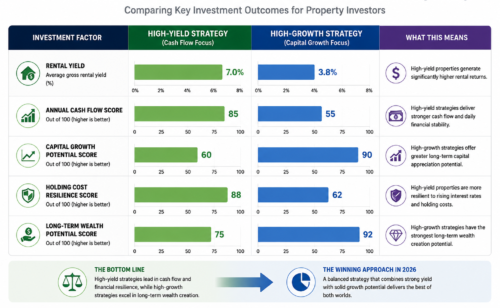
This graph compares the relative performance of high-yield and high-growth investment strategies during 2026.
While high-yield properties are delivering stronger cash flow and financial stability, high-growth properties continue to offer superior long-term equity potential. The data highlights why many investors are now pursuing a balanced approach that combines both benefits.
Frequently Asked Questions
- Is high-yield better than high-growth in 2026?
Not necessarily. High-yield properties offer stronger cash flow, while high-growth properties may generate greater long-term wealth. - Why are investors focusing more on yield?
Higher interest rates have increased the importance of cash flow and financial sustainability. - Can a property deliver both yield and growth?
Yes. Many investors seek markets that combine strong rental demand with long-term growth drivers. - Which strategy is less risky?
High-yield properties often provide more immediate income stability, but every investment carries risks. - What is the best approach?
Many investors are now combining both strategies to create a balanced and resilient portfolio.
What This Means for Property Investors
The best strategy depends on your financial objectives, risk tolerance, and investment timeline. Investors seeking stronger cash flow may find high-yield markets particularly attractive in the current environment.
However, those focused on long-term wealth creation should not ignore the importance of capital growth. Markets with strong fundamentals continue to offer significant opportunities despite higher interest rates.
At Citadel Agency, we help investors identify properties that align with both their short-term cash flow needs and long-term growth goals.
Book a personalized property investment consultation today and discover which strategy may be best suited to your goals.