
Foreign investment has long played a role in Australia’s property market, particularly in major cities and high-demand locations. While domestic buyers remain the dominant force in most markets, overseas investment continues to influence specific suburbs and property segments.
In 2026, foreign investment is still concentrated in selected areas rather than spread evenly across the country. Inner-city apartments, premium suburbs, and markets with strong education, employment, and lifestyle appeal tend to attract the highest levels of overseas interest.
For property investors, understanding where foreign capital is most active can provide useful insights into local demand patterns and future market opportunities.
Where Foreign Investment Is Most Concentrated
Foreign buyers are typically drawn to markets with global recognition, strong infrastructure, and access to universities and employment hubs. This is why cities such as Sydney, Melbourne, and Brisbane continue to attract a large share of overseas investment.
Demand is often strongest in new apartment developments, premium suburbs, and areas with high rental demand. Locations close to major transport links and educational institutions are particularly attractive to international buyers and investors.
These concentrated buying patterns mean that foreign investment can have a meaningful impact in selected markets while having little effect in many regional and suburban areas.
Why Overseas Buyers Invest in Australia
Australia remains attractive to international investors because of its stable economy, transparent legal system, and strong population growth. Property rights are well protected, and the market is viewed as relatively secure compared to many other countries.
Many overseas buyers are motivated by education opportunities, migration plans, and long-term wealth preservation. Some purchase properties for family members studying in Australia, while others see Australian real estate as a diversification strategy.
These motivations mean foreign investment is often driven by long-term confidence rather than short-term speculation.
The Impact on Local Property Markets
Foreign investment can increase competition in specific market segments, particularly where supply is limited and demand is already strong. This may contribute to higher prices in selected suburbs and development projects.
However, the effect is usually concentrated rather than broad-based. Most Australian property markets are primarily driven by domestic owner-occupiers and investors.
In many cases, foreign investment also supports new housing construction by helping developers secure project funding and improve overall housing supply.
Government Regulations Limit Participation
Foreign buyers face strict regulations when purchasing Australian property. The Foreign Investment Review Board (FIRB) generally restricts non-residents to new dwellings, vacant land for development, and certain redevelopment opportunities.
These rules are designed to encourage additional housing supply rather than increase competition for established homes. Application fees and compliance requirements also reduce speculative activity.
Which Markets Are Most Sensitive
Some markets are more exposed to foreign demand than others. Premium suburbs, CBD apartment markets, and university precincts often experience the strongest influence.
By contrast, many middle-ring and regional markets are driven almost entirely by domestic demand. In these areas, population growth, affordability, and rental conditions are usually much more important than overseas investment.
This explains why foreign investment can be significant in selected locations without dominating the broader national market.
Share of Property Purchase By Buyer Type (FY2023-24)
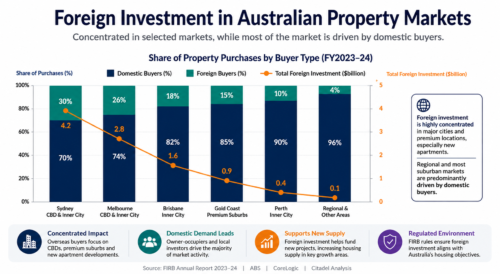
This graph illustrates how foreign investment is concentrated in selected Australian markets, particularly major cities, premium suburbs, and new apartment developments.
It highlights that while overseas buyers can influence localised demand, most Australian property markets remain primarily driven by domestic buyers and investors.
Foreign Investment Is Concentrated in Selected Markets
Foreign investment is concentrated in selected Australian markets, particularly Sydney, Melbourne, and parts of Brisbane where new apartment developments and premium suburbs attract the most overseas interest.
While foreign buyers can increase competition in these specific areas, the broader Australian property market remains overwhelmingly driven by domestic owner-occupiers and local investors. In most suburban and regional markets, local demand, population growth, and housing supply continue to have a much greater influence on price movements than foreign capital.
Frequently Asked Questions (FAQ)
- Does foreign investment drive all Australian property prices?
No. Its impact is concentrated in selected markets, while most areas are driven by domestic demand. - Which cities attract the most foreign investment?
Sydney, Melbourne, and Brisbane are among the main destinations. - Can foreign buyers purchase existing homes?
Generally, non-residents are restricted to new dwellings and development opportunities. - Does foreign investment increase prices?
It can increase competition in specific markets, but its effect is usually localised. - Should investors focus on foreign demand?
It can be a useful factor to consider, but local fundamentals are usually more important.
What This Means for Property Investors
Foreign investment is an important factor in some markets, but it is rarely the sole driver of price growth. Investors should focus on broader fundamentals such as supply, demand, affordability, and rental performance.
Understanding where overseas demand is strongest can help identify markets with additional sources of buyer activity. However, local fundamentals remain the most reliable indicators of long-term performance.
At Citadel Agency, we help investors identify properties that balance cash flow, growth potential, and long-term strategic value. Explore our property strategy resources for more expert insights.
If you’d like tailored guidance based on your investment goals, contact our team for personalized support.