Australia’s property market has remained more resilient than many expected despite higher interest rates, affordability pressures, and ongoing economic uncertainty. Many analysts predicted that rapid interest rate increases would lead to widespread price declines across the country. Instead, property values in many cities have continued to rise or stabilise, supported by strong demand and limited housing supply.
Now that 2026 is underway, investors are asking whether the market is beginning to slow. While there are signs that growth is moderating in some areas, the latest data suggests the market is entering a more balanced phase rather than experiencing a major downturn. Instead of rapid growth across all locations, conditions are becoming more selective depending on supply, affordability, and local demand.
Why Property Growth Has Remained Resilient
One of the biggest surprises in recent years has been the resilience of Australian property prices despite higher borrowing costs. Normally, rising interest rates reduce borrowing capacity and weaken buyer demand. However, the property market has continued to perform better than expected because several powerful factors are still supporting demand.
Population growth has remained strong due to migration, increasing the need for both rental properties and owner-occupied housing. At the same time, low vacancy rates and rising rents have encouraged investors to remain active in the market despite higher repayments. This combination of strong demand and limited supply has prevented the widespread price declines many expected during the recent rate-hiking cycle.
Another important factor is that property markets tend to move more slowly than financial markets. Real estate decisions are often based on long-term confidence rather than short-term economic fluctuations, which helps stabilise prices during uncertain periods.
Affordability Pressures Are Increasing
Although the market has remained resilient, affordability pressures are becoming more visible across many parts of Australia. Higher interest rates have significantly increased mortgage repayments, making it harder for buyers to qualify for loans and comfortably manage repayments.
At the same time, property prices in many areas remain elevated, creating additional pressure on first-home buyers and investors with smaller budgets. Rising household expenses, including utilities, insurance, and living costs, are also reducing disposable income for many Australians.
These affordability constraints are beginning to moderate buyer activity in some markets during 2026, particularly in higher-priced areas where borrowing requirements are already stretched. However, slower activity does not automatically mean falling prices. In many cases, affordability pressure simply reduces the pace of growth rather than causing major declines.
Population Growth Continues to Support Demand
Australia’s population growth remains one of the strongest supports for the housing market in 2026. Increased migration continues to place pressure on housing demand, particularly in major cities and high-growth regional locations.
Every increase in population creates additional demand for housing, whether through rentals or property purchases. This is especially significant in markets already struggling with undersupply. Even when borrowing conditions tighten, population growth can continue supporting property prices because the underlying need for housing remains strong.
This demand is also reflected in rental markets, where low vacancy rates and rising rents continue attracting investors seeking stronger cash flow opportunities.
Supply Constraints Are Still Limiting the Market
Housing supply remains one of the biggest structural challenges facing the Australian property market in 2026. New housing construction has slowed due to rising material costs, labour shortages, higher financing costs for developers, and ongoing construction delays.
As a result, the number of new homes entering the market has not kept pace with population growth and housing demand. This imbalance continues placing upward pressure on both rents and property prices.
Even if buyer demand softens slightly because of affordability pressures, limited supply may continue preventing significant price declines. In many locations, the shortage of available housing remains severe enough to support ongoing market stability.
What the Latest Market Data Suggests
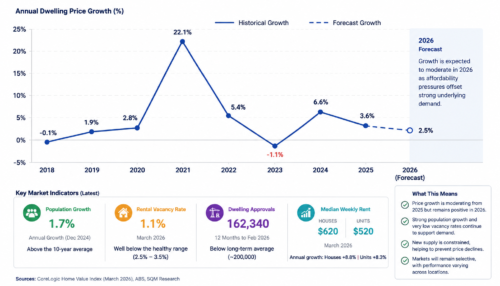
This graph illustrates how Australian property price growth is beginning to moderate during 2026 rather than sharply decline. While growth rates are slower compared to previous years, the market continues to be supported by strong demand fundamentals and limited housing supply.
The data suggests the market is transitioning into a more balanced phase where price growth becomes steadier and more selective across different cities and property types. Rather than a broad national downturn, some areas may continue performing strongly while others experience softer conditions.
Not All Markets Are Behaving the Same
A common mistake investors make is assuming the Australian property market moves as one single market. In reality, every city, suburb, and region behaves differently depending on local supply, demand, infrastructure, employment, and population trends.
Some areas are experiencing slower growth because of affordability pressures or oversupply, while others continue performing strongly due to migration, infrastructure investment, or limited available housing. Markets with strong rental demand and tight vacancy rates remain particularly resilient even as overall growth moderates.
Why Slower Growth Doesn’t Mean a Crash
It is important to distinguish between slower growth and a market crash. Property markets naturally move through cycles of acceleration, moderation, stabilisation, and recovery.
After several years of strong price growth, a slower phase can actually create healthier and more sustainable market conditions. It reduces speculative activity, improves affordability stability, and allows the market to absorb previous growth.
Historically, Australian property markets have often moved through periods of slower growth without experiencing major nationwide declines. This is particularly true when supply remains constrained and population growth continues supporting housing demand.
Frequently Asked Questions (FAQ)
- Are Australian property prices slowing in 2026?
In some areas, yes. Growth is moderating compared to previous years, but the market remains supported by strong demand and limited supply. - Why are prices still holding up despite affordability pressure?
Population growth, low housing supply, and strong rental demand are continuing to support the market. - Will all cities perform the same in 2026?
No. Different markets are performing differently depending on local demand, affordability, and supply conditions. - Does slower growth mean the market is crashing?
No. Slower growth is often a normal part of the property cycle and does not automatically indicate a major downturn. - What should investors focus on in 2026?
Investors should focus on long-term fundamentals such as supply-demand balance, rental demand, and strategic market selection.
What This Means for Property Investors
The key takeaway for investors is that while property price growth may be slowing in some areas during 2026, the broader structural drivers supporting the market remain strong. Instead of focusing only on whether prices will rise or fall, investors should pay attention to supply shortages, rental demand, population growth, and long-term market positioning.
At Citadel Agency, we help investors analyse market conditions beyond the headlines and identify opportunities in changing environments. If you want guidance on positioning your portfolio for the next phase of the market cycle, you can connect with our team. You can also access more insights through our property investment guidance hub.