At first glance, rising interest rates should slow down property investment. Higher borrowing costs reduce affordability, tighten cash flow, and create uncertainty. Yet despite this, many investors are still actively entering the market. This isn’t a contradiction, it reflects a deeper understanding of how property markets actually work. Interest rates matter, but they are only one piece of a much larger picture.
What many investors recognise is that market conditions are rarely perfect, and waiting for ideal timing often leads to missed opportunities. High interest rate environments can create less competition, more negotiating power, and access to properties that may not be available during stronger market conditions. For strategic investors, this period is less about short-term cost and more about positioning for long-term gains.
High Rates Don’t Mean No Opportunities
While higher interest rates increase borrowing costs, they also reduce competition. Many buyers step back during high-rate periods, creating a window where investors can negotiate better deals and access opportunities that may not exist in more competitive conditions. For experienced investors, this environment is not a barrier, it’s a strategic entry point.
In addition, sellers in these conditions are often more motivated, particularly if they are facing higher holding costs or reduced buyer demand. This can create opportunities for investors to secure better purchase prices, more favourable terms, or properties that might otherwise be out of reach in a stronger market. For those who are financially prepared, this shift in leverage can be a significant advantage.
Property Is a Long-Term Investment
One of the key reasons investors continue to buy is because property is not a short-term asset. Decisions are made based on long-term growth, not temporary rate conditions.
Even if interest rates are high today, they will not remain elevated forever. Investors who focus on long-term fundamentals understand that entering the market earlier can position them ahead of future growth phases.
Rental Demand Is Supporting Cash Flow
Strong rental demand has become one of the biggest drivers of investor activity. With more people renting due to reduced borrowing capacity, rental markets across Australia have tightened significantly.
This has pushed rental prices higher, allowing many investors to offset increased interest costs through improved rental income. In some cases, stronger yields are helping maintain or even improve cash flow despite higher repayments.
Supply Constraints Are Keeping Prices Stable
Housing supply in Australia remains limited due to construction delays, rising costs, and labour shortages. This imbalance between supply and demand continues to support property prices. Even in a high interest rate environment, limited supply can prevent significant price declines and create a more stable market for investors.
In addition, new housing supply takes time to respond to market conditions, meaning shortages can persist even as demand fluctuates. With population growth continuing and new developments facing delays, the gap between available housing and demand remains tight. This structural imbalance helps underpin property values, reinforcing why prices can remain resilient despite higher borrowing costs.
Investors Are Thinking Strategically
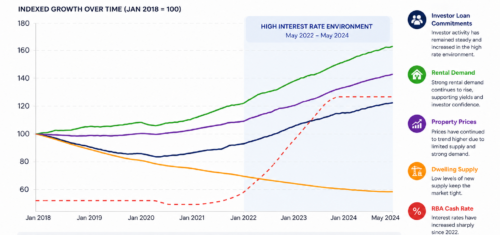
This graph illustrates how investor activity can remain steady, or even increase, despite higher interest rates. While borrowing capacity declines, factors such as rental demand, supply shortages, and long-term growth expectations continue to support investment activity.
It highlights that investors are not reacting to interest rates alone, but to the broader market conditions.
The Advantage of Acting Before the Crowd
Many investors recognise that markets often move before conditions feel “ideal.” Waiting for lower interest rates can mean entering the market alongside a surge of competition.
By acting during periods of uncertainty, investors can position themselves ahead of the next cycle and benefit from reduced competition.
In these conditions, there is often greater opportunity to secure quality assets at more favourable prices, as fewer buyers are actively competing. This early positioning allows investors to capture potential growth as market sentiment improves, rather than chasing the market once momentum has already returned.
Frequently Asked Questions (FAQ)
- Why are investors still buying when interest rates are high?
Because opportunities still exist due to reduced competition, strong rental demand, and long-term growth potential. - Is it risky to invest during high interest rates?
It depends on your strategy. Many investors see this period as an opportunity rather than a risk. - How do investors manage higher repayments?
Through rental income, strategic property selection, and long-term planning. - Will property prices fall if rates stay high?
Not necessarily. Prices are influenced by supply and demand, not just interest rates. - When is the best time to invest?
When market fundamentals align, not simply when rates are low.
What This Means for Property Investors
The key takeaway is that high interest rates don’t eliminate opportunities, they change where those opportunities exist. Investors who understand market cycles, supply-demand dynamics, and long-term growth drivers are better positioned to act strategically.
At Citadel Agency, we help investors understand where the market sits within the cycle so they can make informed, strategic decisions. If you’re planning your next move, you can connect with our team. You can also access more insights through our property investment guidance hub.