
Many investors assume that higher interest rates should lead to widespread property price declines. Rising borrowing costs reduce affordability, limit borrowing capacity, and make buyers more cautious. On the surface, this seems like a recipe for falling prices.
Yet the latest data tells a very different story. Recent PropTrack analysis found that around 70% of Australian suburbs recorded price growth over the previous three months, despite ongoing interest rate pressure and affordability concerns. This highlights an important truth: property markets are influenced by much more than interest rates alone.
Supply Shortages Are Supporting Prices
One of the strongest forces keeping property prices elevated is Australia’s persistent housing shortage. In many cities and regional markets, the number of available properties remains well below underlying demand.
Construction delays, labour shortages, rising development costs, and planning constraints have all limited the supply of new housing. As a result, even when some buyers step back due to higher rates, there are still not enough properties to meet demand.
This shortage creates a natural floor under prices, helping many suburbs continue recording growth.
Population Growth Continues to Drive Demand
Australia’s population growth remains a major support for the housing market. Migration and natural population increases continue adding pressure to an already undersupplied housing system.
Each additional household requires accommodation, whether through renting or purchasing. This sustained demand helps explain why prices continue rising in many suburbs even as borrowing costs remain elevated.
Markets with strong population inflows often experience more resilient price performance due to ongoing competition for limited housing stock.
Rental Demand Is Keeping Investors Active
Strong rental demand is another important factor supporting prices. Vacancy rates remain low across many markets, while rents have risen significantly in recent years.
For investors, higher rental income can offset some of the increased cost of borrowing. This improves cash flow and encourages continued investment activity.
As long as rental demand remains strong, investor participation is likely to continue supporting prices in many suburbs.
Buyer Confidence Has Not Collapsed
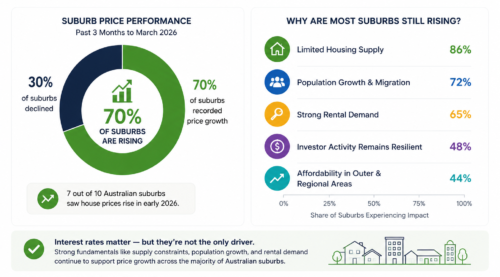
This graph illustrates that the majority of Australian suburbs are still recording price growth in 2026, even with higher borrowing costs. It highlights how supply shortages, population growth, and strong rental demand continue supporting the market.
The data reinforces that interest rates influence the market, but they do not determine outcomes on their own.
Property Markets Are Highly Fragmented
A common misconception is that the Australian property market moves uniformly. In reality, every suburb responds differently depending on local supply, demand, affordability, and economic conditions.
Some premium markets may experience softer conditions, while affordable suburbs and growth corridors continue to perform strongly. This fragmentation explains why national headlines can sometimes appear inconsistent with what is happening on the ground.
Frequently Asked Questions (FAQ)
- Is it true that 70% of suburbs are still rising?
Yes. Recent PropTrack data reported that around 70% of Australian suburbs recorded house price growth over a three-month period in 2026. - Why are prices still rising when interest rates are high?
Supply shortages, strong migration, rental demand, and affordability-driven buying are continuing to support prices. - Are all suburbs performing equally?
No. Affordable and middle-market suburbs are generally outperforming premium markets. - Will higher rates eventually slow the market?
They can moderate growth, but structural housing shortages may continue supporting prices. - What should investors focus on?
Local supply-demand fundamentals, rental yields, and long-term growth potential.
What This Means for Property Investors
The key takeaway is that high interest rates have not been enough to stop price growth in most Australian suburbs. Structural factors such as housing shortages, population growth, and rental demand continue to support the market.
For investors, this means opportunities still exist even when borrowing costs remain elevated. Understanding where demand is strongest is often more important than trying to predict the next rate move.
At Citadel Agency, we help investors identify high-performing markets based on data, supply-demand fundamentals, and long-term strategy. If you want guidance on positioning your portfolio for the next phase of the market cycle, you can connect with our team. You can also access more insights through our property investment guidance hub.