Not every property for sale is a good investment.
A property can look attractive, have a modern kitchen and even generate a strong rental yield, yet still be a poor long-term investment. For investors, the real question is whether the property has the underlying characteristics needed to remain desirable to both tenants and future buyers.
This is where the concept of an investment-grade property becomes important.
An investment-grade property is generally an asset with a combination of strong fundamentals that can support long-term demand, rental performance, capital growth and resale appeal. There is no official Australian definition or government certification for the term, so investors should treat it as an investment framework rather than a formal property classification.
The distinction matters because property investing is ultimately about the quality of the asset being purchased, not simply the number of properties an investor owns.
What Does Investment-Grade Property Mean?
An investment-grade property is an asset that demonstrates characteristics associated with strong long-term investment performance. These characteristics typically include a desirable location, sustainable tenant demand, limited competing supply, good property fundamentals and strong appeal to owner-occupiers.
The most important point is that investment-grade does not simply mean “expensive”. A million-dollar property isn’t automatically a better investment than a $600,000 property. The quality of the underlying market and asset matters far more than the price tag.
An investment-grade property should ideally have multiple sources of demand supporting it. If tenants want to live there today and owner-occupiers would also consider buying it in the future, the property may have a broader, more resilient pool of buyers and tenants.
Location Is One of the First Indicators of Quality
Location plays a major role in determining whether a property can maintain demand over time. Investors should look beyond a suburb’s current median price and examine the characteristics that make people want to live there.
Access to employment, transport, schools, healthcare, shopping, recreation and other amenities can contribute to sustained housing demand. Population growth can also be an important indicator because increasing numbers of households create additional demand for housing. The latest ABS data shows Australia’s capital cities grew by 324,700 people in 2024–25, while regional Australia grew by 94,700 people.
However, population growth alone doesn’t make a suburb investment-grade. Investors need to consider whether the area’s housing supply can keep pace with demand and whether employment and infrastructure are developing alongside the population.
A suburb experiencing population growth without sufficient employment or amenities may not provide the same investment characteristics as a location where population growth is supported by a growing local economy.
Strong Rental Demand Matters
An investment property needs tenants, which makes rental demand an important part of assessing asset quality.
A property with strong tenant appeal can potentially experience shorter vacancy periods and more consistent rental demand. This can help reduce the financial pressure associated with holding an investment property, particularly when interest rates or other ownership costs are elevated.
Tenant demand should be assessed at the property and suburb level, rather than simply looking at city-wide rental statistics. A suburb may have strong rental demand overall while particular property types struggle to attract tenants.
Consider who is likely to rent the property and why. Proximity to employment, transport, universities, hospitals and lifestyle amenities can all influence tenant demand. The property’s layout, number of bedrooms, parking, outdoor space and overall condition can also determine how competitive it is within the local rental market.
Supply Constraints Can Support Long-Term Performance
An investment-grade property is not only about demand. Supply matters just as much.
If a suburb can easily add large numbers of similar properties, investors may face greater competition from newly constructed homes and apartments. This can affect both rental demand and resale conditions, particularly when buyers have many comparable properties to choose from.
Markets with constrained land availability, established infrastructure and limited opportunities for large-scale new development can have different supply dynamics. However, investors need to distinguish between genuine scarcity and marketing claims about “limited supply”.
A property may be physically scarce but still have limited investment appeal if demand is weak. The strongest opportunities generally occur when desirable housing meets sustained demand while competing supply remains constrained.
The Property Itself Needs to Be Desirable
A strong suburb cannot compensate for a poor-quality asset.
Two properties located on the same street can have very different investment prospects because of differences in land, layout, condition, orientation, parking, construction quality and overall appeal.
Investment-grade properties tend to have characteristics that make them attractive to a broad group of potential tenants and future buyers. This could include practical floorplans, adequate bedrooms, functional living spaces, outdoor areas, parking and low-maintenance features.
Owner-occupier appeal can be particularly important because owner-occupiers represent a significant portion of the potential resale market. An investment property that appeals only to a narrow tenant group may have a smaller pool of future buyers when it eventually comes time to sell.
Land and Scarcity Can Make a Difference
For detached houses, the underlying land component can be an important consideration when assessing long-term investment potential.
The building itself depreciates and requires maintenance, while land is finite. In locations where demand continues to increase but the ability to create additional housing is constrained, well-positioned land can become increasingly valuable.
This does not mean every house on a large block is automatically investment-grade. The land needs to be in a location where people actually want to live, and the surrounding market needs to support sustained demand.
For apartments and other higher-density properties, investors need to consider the opposite issue: how much competing stock exists and whether future development could increase supply significantly.
Capital Growth Potential Should Be Supported by Fundamentals
Capital growth is one of the biggest reasons Australians invest in property, but past price increases should not be confused with future potential.
An investment-grade property should ideally be located in a market where there are identifiable reasons for future demand and price growth. These can include population growth, employment expansion, infrastructure improvements, constrained supply and improving amenity.
Historical performance can provide useful context, but it should not be the sole reason for purchasing an asset. A suburb that has already experienced substantial growth may have less room for further outperformance if its underlying fundamentals have weakened.
Investors should therefore ask a more useful question: What is likely to continue driving demand for this property over the next five to ten years?
For a deeper look at the factors that can support property capital growth, see our article.
Why employment growth matters when assessing an investment-grade property
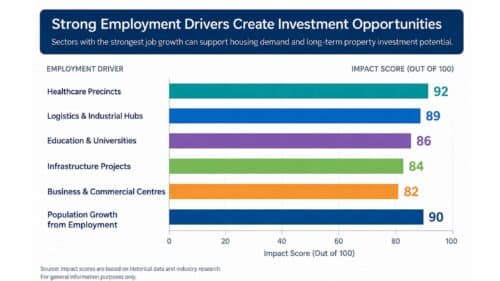
Employment growth can be an important indicator of future housing demand. Healthcare and social assistance, education, professional services and other service-based industries are expected to account for a significant share of Australia’s future employment growth, according to Jobs and Skills Australia.
For property investors, the key consideration is not simply how many jobs exist today, but whether an area has the economic foundations to attract more jobs and more people over time. Employment hubs can support population growth and rental demand, particularly when new infrastructure and housing supply are developing alongside them.
Rental Yield Should Be Considered, But Not in Isolation
Rental yield is an important part of assessing an investment property, particularly when determining whether the asset is financially sustainable to hold.
However, a high rental yield does not automatically make a property investment-grade. Higher yields can sometimes occur in locations where capital growth prospects, population growth or resale demand are weaker.
Conversely, properties in tightly held markets with strong owner-occupier demand may have lower initial yields but stronger long-term capital growth potential.
The goal is to understand how rental income fits into the overall investment performance. Investors should consider the relationship between yield, capital growth, vacancy, holding costs and asset quality rather than selecting a property based on the highest advertised rental return.
Low Maintenance and Practical Ownership Matter
An investment-grade property should also make sense from an ownership perspective.
A property requiring constant repairs, major renovations or expensive ongoing maintenance can erode returns even if its suburb performs strongly. Investors should assess the property’s age, construction quality, maintenance requirements and potential future capital expenditure before purchasing.
This is particularly important when comparing properties that appear similar on the surface. Two homes may have comparable prices and rental yields, but one may require substantially more ongoing expenditure.
A lower-maintenance property can provide greater predictability for investors and may also be easier to manage as part of a growing portfolio.
Resale Appeal Is an Often-Overlooked Factor
Investors should consider who will want to buy the property in the future.
A property with broad appeal can potentially attract both investors and owner-occupiers when it comes time to sell. This can provide a larger potential buyer pool than a highly specialised property designed for a very narrow market.
Think about the property five or ten years from now. Will the layout still be practical? Will the location remain desirable? Will there be significant competing supply? Could a future owner comfortably live in the property?
These questions help investors look beyond today’s rental return and consider the property’s long-term marketability.
What an Investment-Grade Property Is Not
Investment-grade does not necessarily mean a brand-new property, a luxury home or a property with the highest rental yield.
It also does not mean buying in the suburb that has recently recorded the biggest price increase. Past performance can be useful, but it does not guarantee future results.
Likewise, affordability alone does not make a property investment-grade. A cheap property in a market with declining population, weak employment and excessive housing supply may remain a poor investment regardless of how affordable it appears.
The strongest assets tend to combine several favourable characteristics rather than relying on one attractive statistic.
How to Assess an Investment-Grade Property
When assessing a potential investment, investors should look at the property from several perspectives at once.
First, assess the market. Is population increasing? Is employment growing? Is infrastructure improving? Is there sustained rental demand? Is new housing supply likely to increase significantly?
Then assess the asset. Is the property well located within the suburb? Does it have a practical layout? Is it likely to appeal to tenants? Would owner-occupiers want to buy it? Are the maintenance requirements reasonable?
Finally, assess the numbers. Does the purchase price make sense relative to comparable properties? Is the rental income realistic? What are the expected holding costs? Does the property still make sense if interest rates, vacancy or maintenance costs change?
This process helps investors avoid making a decision based on a single appealing feature.
Why Investment-Grade Quality Matters
Buying an investment property is a significant financial decision, and the quality of the initial asset can influence everything that follows.
A high-quality property in a strong market can provide a foundation for future equity growth, rental income and portfolio expansion. A poorly selected asset, on the other hand, can consume borrowing capacity and capital without delivering the performance an investor expected.
Australian government financial guidance also highlights that property comes with risks including vacancies, interest rate changes, ongoing costs and the possibility of losing value.
That is why investors should assess the underlying quality of an asset before focusing on how it fits into a larger portfolio.
Conclusion
So, what makes a property investment-grade in Australia?
It isn’t one particular property type, suburb or price point. Investment-grade quality comes from the combination of strong location fundamentals, sustainable demand, appropriate supply levels, desirable property characteristics, rental appeal, reasonable holding costs and long-term resale potential.
The most important consideration is whether the property has genuine reasons to remain in demand over time.
For investors, this means looking beyond the listing photos, advertised rental yield or latest suburb growth statistic. A quality investment is one that can withstand changing market conditions because the fundamentals supporting its demand remain strong.
Looking for an Investment-Grade Property?
Identifying a genuinely investment-grade property requires more than searching listings and comparing asking prices. It requires understanding the market behind the property and assessing whether the asset has the fundamentals to perform over the long term.
At Citadel Agency, our property research and acquisition process is designed to identify opportunities based on market fundamentals, investment criteria and detailed property analysis. We help investors assess not only where to buy, but which individual property is worth buying.
If you’re looking for an investment-grade property that fits your long-term goals, speak with the Citadel Agency team about your next investment.