
Buying an investment property involves more than finding a property in a suburb that appears to be performing well. A property can have an attractive purchase price, strong advertised rental yield or impressive recent growth while still carrying risks that could affect your cash flow, rental income, future value or ability to sell.
Understanding these risks before making an offer allows investors to investigate the property more carefully and determine whether it fits their broader investment strategy. The goal is not to eliminate every possible risk, because property investment will always involve some uncertainty, but to identify the risks that can be measured, managed or avoided.
Look Beyond the Property and Assess the Location Risk
One of the first risks investors should investigate is the location itself. A property may look appealing on inspection, but its long-term investment performance can be affected by employment opportunities, population trends, infrastructure, transport, amenities and the supply of competing properties.
Look at whether people are actually choosing to live in the area and what is driving that demand. Population growth, employment hubs, schools, healthcare facilities, transport connections and major infrastructure projects can all influence the underlying demand for housing.
It is also important to consider whether the suburb is heavily dependent on a single industry or employer. An area that relies heavily on one economic sector may be more exposed if employment conditions change. Diversified local economies can provide a broader base of housing demand.
Investors should also investigate local risks such as flood exposure, bushfire risk, environmental restrictions, major roads, industrial activity or other factors that could affect tenant appeal and future resale demand.
For a deeper look at how location fundamentals influence an investment property, see Citadel Agency’s guide to investment property capital growth and high-performance assets.
Test the Financial Risk Before Buying
A property can appear profitable when looking only at its advertised rental yield. However, investors need to consider the complete financial position, including mortgage repayments, council rates, insurance, property management, maintenance, land tax where applicable, body corporate costs and periods without a tenant.
Moneysmart highlights several risks associated with investment property, including the possibility that rental income may not cover mortgage repayments and other expenses, higher repayments when interest rates rise, vacancy periods and the potential for the property value to fall. It also notes that property has relatively high entry and exit costs.
This is why investors should stress-test the numbers before purchasing. Consider what happens if the property is vacant for several weeks, maintenance costs are higher than expected, the interest rate changes or the achievable rent is lower than the advertised estimate.
The investment should still be manageable under less favourable conditions. If the numbers only work under perfect assumptions, the property may carry more financial risk than the headline figures suggest.
Investigate Property Condition, Legal and Insurance Risks
The physical condition of a property can create significant costs after settlement. Before buying, investors should investigate the building’s age, structure, roof, plumbing, electrical systems, drainage, renovations and any obvious maintenance issues.
A professional building and pest inspection can help identify issues that may not be visible during a normal inspection. For apartments and other strata properties, investors should also review relevant strata or owners corporation information to understand upcoming works, levies, building defects and financial obligations.
Legal and property-specific risks also deserve attention. Check the title, easements, zoning, planning restrictions, approved use and any other relevant property information before committing to the purchase. The exact requirements and cooling-off arrangements can also vary between Australian states and territories, so investors should obtain appropriate legal advice for their circumstances.
Insurance is another important part of the assessment. A property exposed to flood, bushfire or other hazards may have higher premiums or more complicated insurance requirements. Understanding these costs before purchasing can prevent an unpleasant surprise after settlement.
Examine Rental Demand and Future Housing Supply
Rental demand is one of the most important factors when assessing an investment property. A property that is difficult to rent can create vacancy periods, reduce income and place additional pressure on the investor’s cash flow.
Look beyond the current rental listing. Examine comparable properties, vacancy conditions, tenant demographics, rental price movements and the types of properties renters are actively seeking. A property that appeals to a broad tenant market may provide more flexibility when finding a new tenant.
Future housing supply is another risk that can easily be overlooked. New developments entering a suburb can increase competition between landlords, particularly when multiple properties offer similar features.
The latest ABS data shows that 16,953 dwellings were approved across Australia in August 2026, down 6.1% from July but still 10.3% higher than August 2025. The data also shows that private-sector house approvals increased 18.4% year-on-year.
Australian Dwelling Approvals
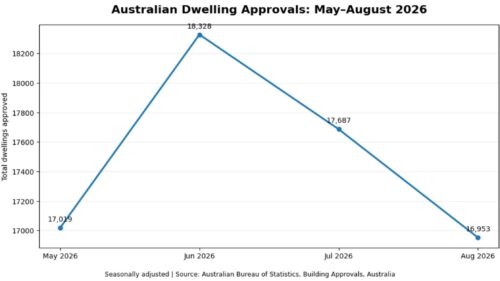
The graph below shows the movement in total dwelling approvals from May to August 2026. It illustrates why investors should investigate not only the existing housing market but also the amount of new housing that may enter the market.
In August, total dwelling approvals fell to 16,953 from 18,328 in June. However, approval volumes can fluctuate from month to month, so investors should look at longer-term supply trends and, more importantly, investigate the specific suburb or market they are considering.
Assess the Investment’s Long-Term Risk and Exit Strategy
The final risk to consider is whether the property still makes sense if market conditions change. Investors should avoid assessing a property purely on what has happened over the previous 12 months.
Consider how the property might perform if growth slows, rental conditions soften or buyer demand changes. Ask whether the property has characteristics that could continue to attract tenants and buyers in different market conditions.
Resale liquidity is particularly important. An investor may eventually need to sell to rebalance their portfolio, access capital or move into another investment. Properties with limited buyer appeal, unusual configurations, significant maintenance requirements or a very narrow tenant market may carry greater exit risk.
This is where the difference between a good property and a good investment becomes important. A property can be attractive personally while still having characteristics that make it less suitable for an investment strategy.
Conclusion
Identifying the risks of an investment property before buying is an important part of building a resilient property portfolio. Investors should examine the location, financial position, physical condition, legal and insurance considerations, rental demand, future housing supply and potential exit strategy before making a commitment.
No investment property is completely risk-free. The objective is to understand the risks clearly, test the assumptions behind the investment and determine whether the property still makes sense when conditions are less favourable.
A research-led approach can help investors make decisions based on evidence rather than relying solely on advertised rental yields, recent price growth or the appearance of the property.
Looking for an investment property with the risks properly assessed?
At Citadel Agency, property investment is approached through research, market analysis and a long-term strategic perspective.
Speak with our team to explore how a research-led approach can help you identify opportunities while understanding the risks before you buy.