In this article 9 sections
- What is a property valuation?
- How do you calculate property value yourself?
- What are the three ways valuers work out property value?
- Is the council valuation the same as market value?
- What does the agent’s price guide tell you?
- When do you need a formal valuation?
- Can you work out what a property will be worth in 10 years?
- How does a buyers agent value a property before you buy?
- Property valuation FAQ
To value a house in Australia, compare it with the sale prices of similar homes nearby that sold recently, then adjust for differences in land size, condition and features. For an investment property, check that price against the rent the home can earn. An online estimate is a starting point only: a formal valuation is done by a qualified valuer, and lenders order their own. The steps below show how to calculate property value and work out how much a property is worth before you make an offer.
What is a property valuation?
A valuation is an estimate of a property’s market value at a set date. The Australian Taxation Office describes market value as the amount a willing buyer and a willing seller would agree to in an arm’s length transaction, based on the most valuable use of the asset. That is the idea every method below is trying to measure.
How do you calculate property value yourself?
You can get a sound estimate in five steps, using the same logic a valuer or buyers agent uses.
- Find three comparable sales. Look for homes of a similar standard and condition that sold recently and close by. Victoria’s rules for estate agents are a useful benchmark: in metropolitan Melbourne a comparable sale must be within 2 km and sold in the last 6 months; outside Melbourne, within 5 km and sold in the last 18 months.
- Adjust for the differences. Compare land size, number of bedrooms and bathrooms, car spaces, condition, renovations and street position. Adjust each comparable up or down to match the home you are valuing.
- Read the agent’s price guide. In Victoria the agent’s estimated selling price must be reasonable and take into account the three most comparable sales. It is shown on the Property Price Statement for the listing.
- Check it against the rent. For an investment, divide the yearly rent by the price and multiply by 100 to get the gross rental yield. If the yield is far below similar homes in the area, the price may be high for an investor. Our rental yield calculator does this for you.
- Get a formal valuation when it matters. For tax, family transfers or a dispute, use a qualified valuer. Your lender will also order its own valuation before it approves a loan.
What are the three ways valuers work out property value?
Sales comparison method
The most common method for houses and units. The valuer compares the property with recent sales of similar homes nearby and adjusts for the differences. It works best where there are plenty of recent sales.
Income (capitalisation) method
Used mostly for commercial property and as a cross check for residential investments. The valuer estimates the yearly rent, takes off vacancy and running costs to get the net income, then divides it by the return investors expect for that type of property.
Cost (summation) method
The value of the land plus the cost of building the improvements today, less wear and age. It suits new builds, unusual homes and properties with few comparable sales.
Is the council valuation the same as market value?
Not quite. In Victoria the Valuer-General oversees valuations every year for council rates, land tax and the Emergency Services and Volunteers Fund levy, under the Valuation of Land Act 1960. Three values are set:
- Site Value (SV): the land only, as if vacant.
- Capital Improved Value (CIV): the land plus buildings and other improvements.
- Net Annual Value (NAV): for homes, 5% of the CIV.
Revaluations have been done every year since 2019. At 1 January 2026, Victoria’s 3.48 million rateable and leviable properties were valued at $3.41 trillion. Because the values are set at 1 January for rates and tax, they can differ from what a buyer would pay today. Other states have their own valuation systems, and the rules and value types differ, so check the Valuer-General or revenue office in your state.
What does the agent’s price guide tell you?
In Victoria, the estimated selling price can be a single price or a range of no more than 10%. If it stops being reasonable, the agent must update it in writing and in the advertising. New price transparency rules now also require agents to publish the seller’s reserve at least 7 days before an auction or fixed date sale, publish the final sale price within 7 days of a sale becoming unconditional, and use the Property Price Statement in place of the Statement of Information. Use the comparable sales listed on it as a starting point for your own check.
When do you need a formal valuation?
The ATO says you must obtain a market valuation when tax law requires one, and it must be objective and supportable. Examples it lists include transfers between related parties, such as family members, and when you start to use your home to earn rent. A lender’s valuation is a separate report the lender orders for its own purposes. This is general information only, not tax or financial advice: speak with your accountant or a qualified valuer about your situation.
Can you work out what a property will be worth in 10 years?
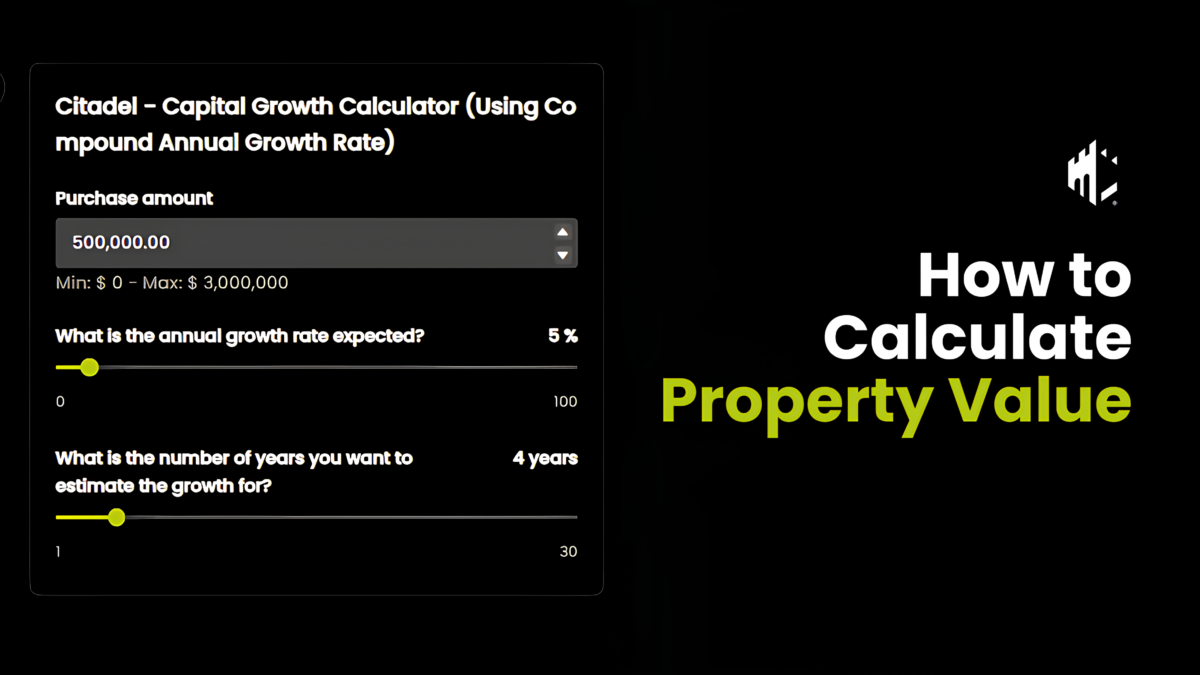
No one can know that. What you can do is test scenarios. Our property growth calculator shows what different yearly growth rates would mean for a price over time. Treat the results as what if numbers, not a forecast. Past performance is not a reliable indicator of future performance.
How does a buyers agent value a property before you buy?
At Citadel Agency we check every property against recent comparable sales, the rent it can earn and the due diligence findings before we negotiate. That helps you avoid paying more than the evidence supports. See how our buyers agent service works and the properties we have secured for clients, or book a strategy call.
Property valuation FAQ
What is the most accurate way to value a house?
A formal valuation by a qualified valuer, who inspects the home and compares it with recent sales of similar properties nearby.
How many comparable sales should I use?
At least three. Victorian agents must base their estimated selling price on the three most comparable sales.
Are online property value estimates accurate?
They are a rough guide. They rely on sales data and cannot see the condition, renovations or position of a particular home, so check them against recent sales yourself.
What is the difference between site value and capital improved value?
Site value is the land only, as if vacant. Capital improved value is the land plus the buildings and other improvements.
How do I check if an investment property is priced fairly?
Compare it with recent nearby sales, then compare its gross rental yield with similar homes in the area. A much lower yield can mean the price is high for an investor.
General information only, not financial, tax or legal advice.
Sources: ATO, Market valuation of assets; Consumer Affairs Victoria, Underquoting information for real estate agents; Valuer-General Victoria, Valuations for rates and land tax; Valuer-General Victoria, Revaluation 2026 outcomes. Opened 26 October 2026.
General information only. It does not take your objectives, financial situation or needs into account and is not financial, tax, credit or legal advice.