

Buying property in Australia involves more than choosing the right location and agreeing on a price. The way a property is sold can affect how you negotiate, the conditions you can include in your offer, the time available to complete your checks and the risks you take before signing a contract.
Two common methods are buying at auction and buying through a private sale, sometimes called a private treaty sale. Auctions can create competition between buyers, while private sales may provide more room to negotiate price and contract conditions. However, neither method automatically guarantees a better purchase.
Understanding the differences between buying at auction vs private sale in Australia can help you prepare a realistic budget, assess the property carefully and make decisions that support your financial goals. The right approach depends on the property, the local market, the applicable state or territory laws, and how well you prepare before making an offer.
Auction vs Private Sale: What Is the Difference?
The main difference is how the purchase price is agreed upon. At an auction, registered bidders compete publicly, and the property is generally sold to the highest bidder once the reserve price and auction conditions are satisfied. In a private sale, buyers negotiate directly with the selling agent, who communicates offers to the seller.
Neither method removes the need for research. Buyers should understand the contract, their financial limits and the property’s condition before making a commitment.
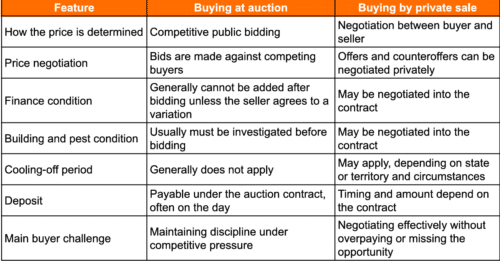
These are general differences, not universal rules. Contract requirements, deposit arrangements and cooling-off rights vary between Australian states and territories.
For buyers considering an auction in New South Wales, the NSW Government’s guide to buying property at an auction explains key requirements and what buyers should understand before bidding.
When Is Buying at Auction the Better Option?
- When You Have Prepared Before Auction Day
An auction may suit buyers who have completed their research, understand the property’s value and are financially ready to proceed. The public bidding process can make competing interest more visible, but it can also encourage buyers to exceed their original budget.
Preparation should include reviewing the contract with a qualified conveyancer or solicitor, arranging suitable building and pest inspections, checking relevant planning restrictions and confirming finance arrangements with your lender or broker. Buyers should also understand the deposit required and how quickly the contract must be signed after a successful bid.
- When Competition Requires a Clear Bidding Strategy
Auctions can be competitive, particularly when a property attracts several interested buyers. Having a maximum price established before bidding helps you make decisions based on your research rather than the pressure of competing in the moment.
Your maximum should reflect more than the advertised price. Consider purchase costs, potential repairs, ongoing holding expenses and whether the property makes sense within your broader financial or investment strategy.
If the bidding moves beyond your limit, walking away may be the most sensible decision. Missing out on one property is preferable to committing to a purchase that no longer fits your budget or objectives.
When Is a Private Sale the Better Option?
- When You Want to Negotiate Price and Contract Conditions
Private sales may offer greater flexibility because buyers can submit an offer and negotiate the terms with the seller. Depending on the seller’s position, you may be able to negotiate the purchase price, settlement period and conditions relating to finance or inspections.
This flexibility can be useful when you need time to finalize lending arrangements or want specific checks completed before becoming unconditionally committed. However, sellers are not required to accept your preferred terms, and competing offers may influence their decision.
In Victoria, private sale purchases may include a cooling-off period, subject to eligibility requirements and exceptions. Buyers in other states and territories should check their own jurisdiction’s rules rather than assuming the same protections apply.
- When You Need Time to Assess the Property
A private sale may give buyers an opportunity to negotiate a conditional offer, allowing certain matters to be resolved before the contract becomes unconditional. The actual protection available depends on the wording of the contract and whether the seller agrees to the conditions.
Use this opportunity to investigate the property’s condition, compare recent sales, assess rental demand if buying an investment property and review any relevant planning or title restrictions. Do not assume that a private sale automatically provides a cooling-off period or the right to withdraw without consequences.
A property can appear attractive at the asking price but become a poor purchase once repairs, insurance costs, rental limitations or other risks are considered. The goal is to assess the entire purchase, not simply negotiate a lower price.
The Risks Buyers Should Check Before Choosing Either Method
- Financial Risks and Paying Too Much
One of the biggest risks is paying more than the property is worth or more than your financial position can comfortably support. Auction competition can intensify this risk, but private sale buyers can also overpay if they rely on asking prices, sales-agent claims or a strong emotional attachment to the property.
Compare the property with recent, relevant sales and assess whether the asking price or likely auction result aligns with its location, condition and features. If the purchase is an investment, consider rental income, vacancy risk, ongoing expenses and the property’s potential to support your long-term strategy.
- Property Condition, Legal and Contract Risks
A property’s appearance does not reveal every issue that could affect its value or future use. Building defects, pest damage, easements, planning restrictions, unapproved alterations and environmental hazards can create additional costs or limit what an owner can do with the property.
Before bidding or making an unconditional offer, review the contract with a qualified legal professional and arrange the appropriate inspections. For an investment property, consider whether the property can be rented as intended and whether the expected income and expenses are realistic.
Buyers should also understand the consequences of signing a contract. At an auction, the successful bidder is generally expected to proceed under the contract terms, with limited scope to withdraw simply because they change their mind. In a private sale, the protections and exit options depend on the contract and applicable law.
- Market Risks and Investment Suitability
A property can be well presented and competitively priced yet still be unsuitable for your goals. Local employment conditions, population trends, infrastructure delivery, housing supply and rental demand can all influence future performance.
Investors should examine the suburb and the individual property rather than relying on broad claims about a location being a growth hotspot. A strong market outlook does not guarantee that every property in the area will perform well.
This is particularly important when comparing properties sold through different methods. The buying process should not determine whether you purchase an asset. Your research, financial position and investment criteria should determine whether the property is worth pursuing.
How to Choose the Right Method for Your Property Purchase
- Start With Your Budget and Objectives
Before deciding how to buy, clarify what you need from the property. An owner-occupier may prioritise location, lifestyle and the ability to move in by a certain date. An investor may place greater emphasis on rental demand, capital growth potential, holding costs and the property’s suitability for a long-term portfolio.
Your budget should account for the full cost of the purchase, including transaction costs, inspections, insurance and any immediate repairs. If you are borrowing, confirm your finance position with your lender or broker and understand the limits of any pre-approval.
Once your priorities are clear, compare the property against them. A competitive auction should not make you overlook a major drawback, and a negotiable private sale should not convince you to buy an asset that fails to meet your requirements.
- Complete Due Diligence Before Committing
Due diligence is important regardless of the sales method. Buyers should assess the property’s condition, legal position, market value, likely costs and suitability before signing unconditionally or making a binding bid.
A structured process can help you identify issues that may not be obvious during an inspection or from the listing description. It also provides a consistent basis for comparing several properties, rather than making each decision in isolation.
Citadel Agency’s Pre-Purchase Property Review supports informed decision-making through an evidence-based assessment before buyers commit unconditionally. This can be particularly valuable when weighing up a property’s potential against the risks and costs that may affect its performance.
Make the Decision Based on Evidence, Not Pressure
The best buying method is the one that allows you to purchase a suitable property on terms you understand and can afford. Auctions may suit prepared buyers who are comfortable with competitive bidding, while private sales may offer more opportunity to negotiate conditions. Both require a clear strategy and appropriate professional advice.
If you are unsure which method is best for a particular property, consider the seller’s expectations, the level of competition, your finance position and the time available for inspections and contract review. These factors are often more important than choosing one method as a general rule.
Frequently Asked Questions
- Does the highest bidder always win at a property auction?
Not necessarily. The outcome depends on the auction conditions, whether the reserve price has been reached and the seller’s instructions. If bidding does not reach the reserve, the property may be passed in, after which the seller may negotiate with interested buyers. - What happens if my pre-auction offer is rejected?
You can decide whether to revise your offer, continue preparing for the auction or walk away. Before increasing your offer, reassess the property’s value and your maximum budget. A rejected offer does not mean the property is worth paying more for. - Can I withdraw an offer on a property before the contract is signed?
Possibly, but the answer depends on how the offer was made, whether it has been accepted, any documents or terms involved, and the applicable state or territory law. Do not assume an offer can always be withdrawn without consequences. Seek advice from a conveyancer or solicitor if you are unsure of your position. - Who decides the settlement date when buying at auction or by private sale?
The settlement date is generally set out in the contract. In a private sale, buyers may be able to negotiate the date with the seller before the contract is finalised. At auction, the contract usually specifies the settlement terms, so buyers should review these before bidding. - What should I do if a property is passed in at auction?
If a property is passed in, the seller may negotiate with interested buyers, subject to the circumstances and applicable rules. Before entering negotiations, revisit your valuation, inspect any outstanding risks and establish a firm price limit. Being able to negotiate after an auction does not automatically make the property a good purchase
Make Your Next Property Purchase With Confidence
Choosing between an auction and a private sale is only the beginning. The more important task is knowing what the property is worth, what risks it carries and whether it fits your goals before you commit.
Citadel Agency helps Australian property buyers take a research-led approach to purchasing, with a focus on market evidence, property fundamentals and informed decision-making.
If you are weighing up an auction property or a private sale, contact our team to understand the property before signing unconditionally.