
Finding an investment property is not simply about finding a property you can afford to buy. The more important question is whether the property makes sense as an investment after considering its income, expenses, risks, market fundamentals and long-term potential.
There will be situations where an investor has already spent considerable time researching a property, negotiating with the seller or imagining the potential returns. That can make walking away difficult, particularly when emotions become attached to the opportunity.
However, being willing to walk away is an important part of disciplined property investing. If the numbers do not work, the risks are too high or the underlying fundamentals are weak, continuing with the purchase simply because you have already invested time into it can make a poor investment even more expensive.
Walk Away When the Numbers Only Work Under Perfect Conditions
One of the clearest reasons to walk away is when the investment only works if everything goes according to plan.
An investor should calculate the expected rental income against the full cost of owning the property. This includes mortgage repayments, property management, insurance, council and water rates, maintenance, land tax where applicable, body corporate costs and other ongoing expenses.
Moneysmart specifically warns investors not to rely on rental income to cover the mortgage because there may be periods when the property is vacant. It also highlights interest-rate increases, falling property values, high entry and exit costs and ongoing ownership expenses as risks investors need to consider.
A useful test is to ask what happens if the property is vacant for several weeks, the achievable rent is lower than expected or an unexpected repair is required. If the investment becomes financially difficult under relatively reasonable scenarios, that is a warning sign worth taking seriously.
The investment should survive a stress test
A property does not necessarily need to produce positive cash flow from day one to be a good investment. However, the investor needs to understand exactly how much they may need to contribute and whether that contribution remains manageable over time.
If the projected return depends on maximum rent, zero vacancy, minimal maintenance and favourable interest rates all at once, the investment may be relying too heavily on assumptions rather than evidence.
Walk Away When the Location Fundamentals Are Weak
A property can look excellent on inspection and still be a poor investment if the surrounding market does not have strong underlying demand.
Before buying, investigate population trends, employment, infrastructure, rental demand, vacancy rates, amenities and future development. These factors help determine whether people are likely to continue wanting to live in the area.
A particularly important warning sign is when the investment case is based almost entirely on the property being “cheap”. A low purchase price does not automatically create a good investment. If the area has weak employment drivers, limited tenant demand or poor long-term buyer appeal, the lower price may simply reflect the additional risk.
Investors should also investigate what is happening around the property rather than looking only at the immediate street. Proposed developments, major infrastructure changes, zoning changes or significant increases in housing supply can influence future rental and resale demand.
Walk Away When Rental Demand Does Not Support the Numbers
A strong advertised rental yield can be misleading if the property is difficult to lease.
Before purchasing, compare the property with similar rental listings and investigate vacancy conditions. Consider how long comparable properties typically remain available, what rents are actually being achieved and whether the property’s features match what local tenants are looking for.
This is particularly important when the property’s projected return is dependent on achieving an ambitious rental figure. If comparable properties are consistently renting for less, the investment’s financial model may need to be recalculated.
The same applies to properties with very narrow tenant appeal. An unusual floor plan, limited parking, poor access or significant maintenance requirements could reduce the potential tenant pool and increase vacancy risk.
If the investment only works at a rent that the market does not appear willing to pay, that is a strong reason to reconsider the purchase.
Walk Away When the Property Has Risks You Cannot Control
Some property risks can be managed. Others can make the investment fundamentally less attractive.
Building defects, significant structural problems, flood exposure, bushfire risk, difficult insurance conditions, restrictive easements or major planning issues can materially affect the economics of an investment. These issues should be investigated before committing to the property rather than discovered after settlement.
The same principle applies to properties with unusually high ongoing costs. A low purchase price can become much less attractive if the property requires extensive repairs, has substantial strata obligations or is likely to require major capital expenditure.
Due diligence is therefore about more than confirming that a property looks good. It is about identifying the risks that may affect its income, expenses, future value and resale appeal.
If a major risk cannot be quantified, managed or reasonably compensated for in the purchase price, walking away may be the more disciplined decision.
Walk Away When the Long-Term Investment Case Is Weak
Perhaps the most important question is whether the property still makes sense beyond the first few years.
Investors should not rely solely on recent price growth to justify a purchase. Instead, consider what is likely to support future demand. Population growth, employment, infrastructure, housing supply, rental demand and the scarcity or desirability of the property can all contribute to the long-term investment case.
Current market data also shows why investors should avoid assuming that property values only move in one direction. ABS data for the June quarter of 2026 showed Australia’s total residential dwelling value fell by $34.1 billion, or 0.3%, while the mean dwelling price fell 0.7% to $1.1 million. At the same time, the value of Australia’s dwelling stock remained 8.5% higher than a year earlier.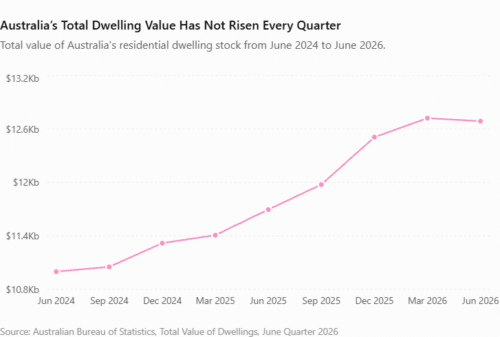
The small decline in the latest quarter is a useful reminder that investors should not build their strategy around the assumption that property prices will continually rise. Even in a market that has recorded substantial annual growth, individual quarters and individual markets can move differently.
If the long-term investment case depends on rapid capital growth to compensate for weak rental demand, poor cash flow or significant property risks, it may be better to walk away and continue looking.
Walking Away Is Part of Good Property Investing
Walking away from an investment property does not necessarily mean the property is bad. It may simply mean that the property is not right for the investor, the strategy or the price being offered.
A property might have strong fundamentals but be overpriced. Another might be affordable but have weak rental demand. A third might look attractive but carry significant maintenance or planning risks. The important thing is to understand why the property does not work rather than trying to convince yourself that it will somehow become a better investment later.
The strongest investors are not necessarily the ones who buy the most properties. They are the ones who can identify when an opportunity does not meet their criteria and have the discipline to wait for a better one.
A Simple Walk-Away Checklist
Before making an offer, ask:
- Do the numbers work with realistic rent and expenses? If not, reconsider the purchase.
- Can I comfortably manage the property if it is vacant? If a short vacancy creates serious financial pressure, the investment may be too stretched.
- Is rental demand supported by actual market evidence? Do not rely solely on an agent’s rental estimate.
- Are there major property or location risks? Investigate building condition, insurance, flood or bushfire exposure, planning and other relevant risks.
- Is the property fairly priced? Compare it with recent comparable sales rather than relying solely on the vendor’s asking price.
- Does the location have strong underlying fundamentals? Look beyond recent capital growth.
- Would I still want to own this property if prices stopped rising for several years? This is one of the simplest ways to test whether the investment is fundamentally sound.
- Does it fit my overall strategy? A property can be a good asset but still be the wrong purchase for a particular portfolio.
Conclusion
Knowing when to walk away from an investment property is just as important as knowing when to buy one.
If the numbers depend on unrealistic assumptions, rental demand is weak, property risks are difficult to manage or the long-term fundamentals do not support the investment case, continuing with the purchase simply because you have already invested time into it can be costly.
Property investing rewards patience. There will always be another property, another suburb and another opportunity. Walking away from an investment that does not meet your criteria can protect your capital and leave you in a stronger position when the right opportunity comes along.
The goal is not to buy a property. The goal is to buy the right property at the right price for the right investment strategy.
Ready to Find the Right Investment Property?
The ability to walk away from the wrong property starts with having clear investment criteria before you buy.
Citadel Agency takes a research-led approach to property investment, helping investors assess markets and properties based on data, fundamentals and long-term potential.
Speak with our team to explore your next investment opportunity.