
Australia’s property market is no longer moving in one direction. While some suburbs and property segments continue recording strong growth, others are slowing significantly under the pressure of higher interest rates. This growing divide is creating what many analysts describe as a “two-speed” property market.
In 2026, rising interest rates are affecting buyers and investors differently depending on location, affordability, borrowing capacity, and rental demand. Affordable markets with strong population growth and limited supply are continuing to attract demand, while some premium and highly leveraged segments are experiencing softer conditions.
For investors, this means market selection has become more important than ever. Understanding which areas are benefiting from current conditions and which are struggling is now critical to making informed investment decisions.
What Is a Two-Speed Property Market?
A two-speed property market occurs when some parts of the market outperform while others lag behind. Instead of national prices moving uniformly, different suburbs and property types respond differently to economic conditions.
This divergence becomes more visible during periods of higher interest rates because borrowing capacity, affordability, and buyer sentiment are affected unevenly across the market.
Affordable housing segments often remain more resilient because they attract a broader pool of buyers and renters, while premium markets may experience reduced demand as financing becomes more expensive.
Higher Rates Are Reducing Borrowing Capacity
One of the biggest effects of rising interest rates is reduced borrowing power. As lenders apply higher serviceability assessments, buyers are approved for smaller loan amounts even if their incomes remain unchanged.
This has pushed many buyers toward lower-priced suburbs and more affordable property types. In some cases, buyers who previously targeted premium suburbs are now competing in middle-market areas instead.
As explained in this APRA guidance on loan serviceability buffers, lenders assess borrowers using higher repayment assumptions to ensure they can manage future rate increases.
Affordable Markets Are Outperforming
As borrowing capacity declines, affordable markets are attracting stronger buyer activity. These suburbs often benefit from wider buyer demand, stronger rental yields, and lower entry costs.
At the same time, limited housing supply and population growth continue supporting demand in many affordable areas. This combination is helping some markets outperform despite broader economic uncertainty.
Our article on why affordable properties are outperforming luxury homes in 2026, explores this trend in greater detail.
Premium Markets Are Facing More Pressure
Higher-priced markets are generally more sensitive to rising interest rates because buyers require larger loans to enter these areas. As borrowing costs increase, the pool of eligible buyers can shrink more quickly.
This does not necessarily mean premium markets will crash, but growth may slow significantly compared to more affordable segments. Some luxury and oversupplied apartment markets are already experiencing weaker demand conditions.
In many cases, buyers are becoming more cautious and prioritizing value, cash flow, and financial flexibility rather than prestige alone.
Rental Demand Is Supporting Resilient Markets
Strong rental demand is helping support many outperforming suburbs. Rising migration, low vacancy rates, and affordability challenges in home ownership are keeping pressure on the rental market.
For investors, this means rental income is becoming increasingly important. Markets with strong tenant demand and sustainable rental growth are attracting more investor attention even during periods of higher interest rates.
Rising Rates and the Two-Speed Market
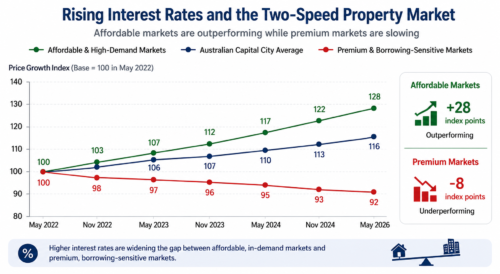
This graph illustrates how rising interest rates are affecting different parts of the Australian property market in very different ways.
Affordable suburbs with strong demand and limited supply are continuing to outperform, while premium and borrowing-sensitive markets are experiencing slower growth and reduced buyer activity.
Frequently Asked Questions (FAQ)
- What is a two-speed property market?
It describes a market where some locations or property types outperform while others underperform. - Why are interest rates creating this divide?
Higher rates affect borrowing capacity differently across various price points and market segments. - Which markets are performing better?
Affordable suburbs with strong rental demand and limited supply are generally outperforming. - Are premium markets declining?
Not necessarily, but many are experiencing slower growth and softer buyer demand. - What should investors focus on in 2026?
Affordability, rental demand, cash flow, and strong local market fundamentals.
What This Means for Property Investors
The rise of a two-speed property market means investors can no longer rely on broad national trends alone. Market selection, affordability, rental demand, and supply conditions are becoming increasingly important.
Investors who focus on resilient, high-demand locations may continue finding opportunities even while other parts of the market slow down.
At Citadel Agency, we help investors identify markets positioned to perform strongly under changing economic conditions. If you’d like tailored guidance, visit our property investment consultation page.
You can also explore more insights through our property investment guidance hub.