

An apartment may look like a strong investment on paper. The purchase price fits your budget, the rent looks attractive, and the regular strata levies seem manageable. But what happens when the building needs major repairs, and the owners corporation does not have enough money to cover them?
This is where special levies in strata properties can catch investors off guard. These additional charges can arise when a building faces unexpected expenses or needs major work that its existing funds cannot cover. Depending on the project and the scheme’s rules, owners may need to contribute thousands of dollars beyond their usual strata fees.
For property investors, these costs can reduce cash flow, affect net returns and put pressure on an investment budget. Reviewing strata records before buying helps you identify potential risks before you commit.
This guide explains how special levies work, what can trigger them, which records to check and how to assess their potential impact on your investment.
What Are Special Levies in Strata Properties?
- How Special Levies Work
A special levy is an additional contribution that a strata scheme or owners corporation raises to cover a specific expense. Regular strata levies generally fund ongoing administration, insurance, maintenance and planned works. Special levies may cover unexpected repairs, major building projects or other expenses that available funds cannot meet.
For example, a building may need urgent waterproofing repairs after discovering leaks across several apartments. If the capital works fund cannot cover the full cost, the owners corporation may need to raise additional money from lot owners.
The amount each owner pays depends on the applicable legislation, the scheme’s allocation rules and the nature of the work. Owners do not necessarily split the bill equally. In NSW, unit entitlements generally determine each owner’s contribution, while Victorian owners corporations typically calculate fees using lot liability, subject to applicable rules and exceptions.
- Why Investors Should Look Beyond Regular Strata Fees
Regular strata fees only tell you part of the story. A building may charge relatively low levies because its ongoing expenses remain modest. However, those fees do not automatically mean the scheme has enough money for major repairs.
An underfunded capital works fund can create future pressure. Ageing lifts, roof damage, concrete deterioration and waterproofing failures can all require substantial spending. If the scheme has not planned or saved for these expenses, owners may need to contribute more.
Investors should therefore assess the building’s financial position alongside the apartment’s purchase price and expected rental income. A property that appears affordable today may carry additional costs that weaken its long-term investment performance.
What Can Trigger a Special Levy?
- Major Building Repairs and Defects
Building defects are one potential reason an owners corporation may need additional funds. Problems with waterproofing, balconies, roofs, facades, plumbing or structural elements can require costly repairs. Some defects also need specialist investigations before the owners corporation can determine the full scope of work.
A building may have known issues that have remained unresolved for years. Other problems may emerge suddenly, even when the property looks well maintained. The important question is whether the owners corporation has identified the issue, obtained professional advice and established a realistic plan to address it.
Review building reports, maintenance records and meeting minutes for recurring defects or proposed repairs. Look for estimated costs, contractor quotes, approved works and discussions about funding. If the records do not explain the issue clearly, ask your conveyancer or solicitor what further information you should obtain.
- Insurance, Legal Disputes and Unexpected Expenses
Special levies do not only arise from physical repairs. An owners corporation may also face unexpected legal expenses, insurance-related costs or other extraordinary expenditure. The circumstances and available funding will determine whether it needs to raise additional contributions.
Insurance deserves particular attention. Premium increases, excesses, coverage limitations or disputes about a claim can affect how much money the scheme needs to contribute towards a problem. Do not assume insurance will cover every repair or eliminate the risk of a special levy.
Meeting minutes and financial statements can help you understand whether the scheme faces these pressures. Check whether owners have discussed disputes, insurance claims, large excess payments or unexpected expenses. Where possible, establish whether the issue has been resolved or could create further costs.
- Poor Planning and Insufficient Capital Works Funds
A well-managed strata scheme plans for major maintenance rather than waiting for problems to become urgent. In NSW, strata schemes must maintain a 10-year capital works plan, subject to the applicable requirements and exemptions. The plan helps forecast future work and the funds needed to complete it.
However, having a plan does not guarantee that the scheme has saved enough money. Actual costs may exceed earlier estimates, building conditions may change, or owners may have approved contributions that prove insufficient.
Compare the available fund balance with the building’s age, condition and planned projects. A low balance may deserve closer attention if the scheme expects to replace lifts, repair balconies or complete other major work soon. The key is to understand the gap between the money available and the likely cost of maintaining the building.
How Much Could a Special Levy Cost an Investor?
- Understand the Potential Financial Impact
The cost of a special levy depends on the total project expense and how the scheme allocates that expense between owners. The following graph illustrates how a building repair bill could translate into an individual contribution when 20 lots share the cost equally.
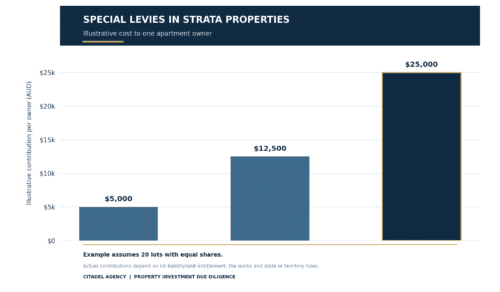
Graph note: These figures are hypothetical examples, not typical or predicted special levy amounts. Actual contributions may differ based on lot liability, unit entitlement, the nature of the works and the rules that apply to the scheme.
A contribution of $5,000 may be manageable for one investor but difficult for another. A larger contribution can put more pressure on cash flow, especially when the investor already has a mortgage, maintenance expenses and other properties to support.
Do not assess the amount in isolation. Consider when the owners corporation expects payment, whether it may approve instalments where permitted, and whether further work could create additional costs. A single levy may also form part of a larger repair program rather than resolve every building issue.
- Calculate the Effect on Cash Flow and Returns
Investors should test how an additional levy could affect their expected returns. Start with the property’s projected rental income, then account for mortgage costs, management fees, insurance, council rates, water charges, regular strata fees and other expenses.
For example, a hypothetical $10,000 special levy would reduce the cash available from an investment by $10,000 before considering any tax treatment or other financial effects. If the property already produces a cash-flow shortfall, the extra expense may require the investor to contribute more money from other income or savings.
Stress-test your investment under several scenarios. Consider a moderate repair contribution, a larger project and the possibility of further work. This approach helps you assess whether you have enough financial capacity to manage unexpected costs without putting other commitments at risk.
What to Check Before Buying a Strata Property
- Review the Strata Report and Financial Records
A strata report can help reveal the building’s financial health, maintenance history and potential liabilities. Review the administrative and capital works funds, recent financial statements, current levies, approved special levies and any proposed major expenses.
Do not stop at the latest balance. Read meeting minutes and financial records to understand how the scheme reached its current position. A healthy balance may still be insufficient if the building faces a major project, while a low balance may reflect recently completed work rather than poor management.
Ask whether the owners corporation has approved a special levy, discussed one or received quotes for significant repairs. Also check the payment schedule and whether the records identify further funding requirements.
- Investigate Planned Works and Unresolved Issues
Look for evidence of future expenses that may not yet appear as an approved special levy. Meeting minutes may mention a proposed facade repair, a lift nearing the end of its service life or repeated water leaks. These discussions can signal future spending even if the owners corporation has not finalized a project.
Check whether the scheme has obtained engineering reports, building assessments or contractor quotes. Find out whether the owners corporation has approved the work and how it plans to fund the project. If the records leave important questions unanswered, seek clarification before proceeding.
Also consider whether a proposed levy would cover the full cost or only one stage of a larger project. A building may need additional work after the initial repairs. Understanding the scope and funding plan can help you avoid underestimating the potential financial commitment.
- Consider the Property’s Overall Investment Risk
Special levies should form part of your wider due diligence, not the only factor in your decision. A building with a well-managed owners corporation and a clear maintenance plan may still offer a suitable investment, even if it requires planned spending. On the other hand, repeated unresolved defects and uncertain funding can increase the risk.
Compare the apartment’s price and expected rental income with its likely ownership costs. Consider the building’s condition, location, tenant demand and future resale appeal. Then decide whether the investment still meets your financial goals after allowing for potential additional expenses.
For a broader assessment, read Citadel Agency’s Complete Investment Property Due Diligence Checklist. It covers other financial, property and market checks investors should consider before committing to a purchase.
How Investors Can Prepare for Special Levies
- Build a Financial Buffer
No amount of research can eliminate every unexpected expense. Investors should maintain a financial buffer that reflects their property portfolio, borrowing commitments and ability to cover sudden costs.
When assessing an apartment, estimate the impact of potential repairs and consider whether your available cash could cover a levy without forcing you to sell assets or miss other payments. The right buffer will differ between investors, so base it on your own financial position rather than a universal figure.
Remember that the levy may not be the only expense. You could also face lost rental income during repairs, higher insurance costs or additional maintenance work. Allowing for these possibilities makes your investment assessment more realistic.
- Ask Questions Before You Commit
Before signing an unconditional contract, make sure you understand the building’s financial position and known maintenance risks. Ask your conveyancer or solicitor to review the relevant records and explain any approved or proposed levies. Where necessary, seek advice from a qualified building professional about significant defects or repair estimates.
If the potential costs remain unclear, consider whether you need more information before proceeding. You may decide to renegotiate the price, seek further professional advice or walk away if the risks do not fit your strategy.
The goal is not to avoid every apartment with a special levy. It is to understand why the levy exists, what it covers and whether the investment remains financially sound after you account for it.
Make Better-Informed Property Investment Decisions
Special levies can turn an apparently affordable apartment into a more expensive investment. The risk often lies not in the levy alone, but in what it reveals about the building’s condition, financial planning and future maintenance needs.
Reviewing strata records, understanding planned works and modelling potential costs can help you assess the investment more accurately. Combine these checks with market research, property inspections and professional advice before committing to a purchase.
Citadel Agency helps buyers assess property opportunities through a research-led approach to property selection and due diligence. Explore our buyers’ agent to learn how we support buyers in making informed property decisions.