

Rental growth across Australia has been one of the most persistent economic stories in recent years. Vacancy rates have tightened, asking rents have climbed sharply, and affordability pressures have intensified across capital cities and regional centres alike.
The key question now facing property investors and tenants is whether this upward trajectory can continue or whether rental markets are approaching a ceiling.
This analysis examines structural supply constraints, migration trends, borrowing conditions, and affordability pressures to assess whether rents are likely to keep rising or stabilise.
Why Rents Rose So Rapidly
Australia experienced an extended period of historically low vacancy rates following pandemic-era border reopenings. A surge in overseas migration combined with limited housing supply placed immediate pressure on the rental market.
Simultaneously, construction delays and rising building costs constrained new dwelling completions. The imbalance between demand and available rental stock resulted in accelerated rent growth across most states.
The rapid pace of increases was not driven by a single factor, but rather by converging structural forces: population growth, constrained supply, and rising financing costs.
Vacancy Rates and Supply Pressures
Rental markets typically soften when vacancy rates rise. However, vacancy levels across major cities have remained well below long-term averages in recent years.
Low vacancy indicates limited available stock relative to demand. When available rental supply remains tight, landlords retain pricing power. However, vacancy rates are beginning to show modest increases in certain metropolitan areas, suggesting early signs of stabilisation rather than continued acceleration.
The key variable to monitor is new dwelling completion rates relative to population growth.
Migration and Population Growth
Australia’s population growth has been driven significantly by net overseas migration. Strong migration inflows increase immediate rental demand, particularly in capital cities.
When migration outpaces housing supply expansion, rents typically rise. However, if migration levels moderate or housing supply accelerates, upward pressure may ease.
Rental demand is therefore highly sensitive to demographic policy settings.
Interest Rates and Investor Behaviour
Higher interest rates increase borrowing costs for property investors. In many cases, increased mortgage repayments have coincided with higher asking rents.
However, there is a natural ceiling to how much rental increases can be absorbed by tenants. When rents consume a greater proportion of household income, affordability constraints begin to limit further growth.
If tenants are unable to pay higher rents, market resistance forms — regardless of landlord cost pressures.
Graph: Rental Growth with 2025 Moderation Projection
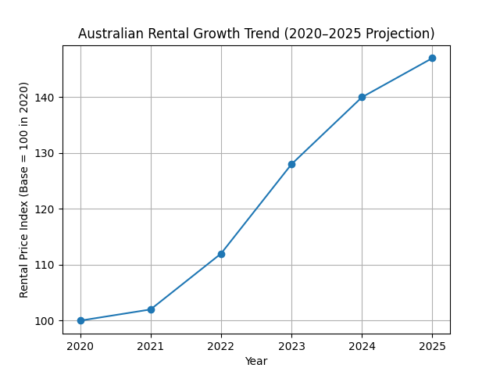
This projection illustrates the sharp acceleration in rental prices from 2022 to 2024, followed by a moderated growth outlook for 2025. While demand pressures remain present, the slowing rate of increase suggests the market is transitioning from rapid surge to stabilised expansion rather than entering a decline.
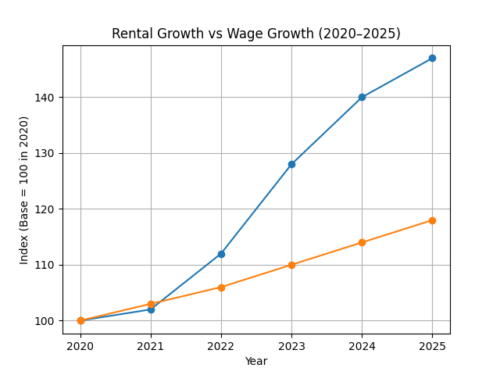
The comparison highlights the widening gap between rental growth and wage growth over the past five years. As rents have risen significantly faster than incomes, affordability constraints are becoming a key factor likely to moderate future rental increases.
Table: Key Market Indicators
|
Indicator |
Recent Trend |
Impact on Rents |
|
Vacancy Rates |
Historically low, slightly rising |
Upward pressure moderating |
|
Net Overseas Migration |
Elevated |
Strong demand support |
|
Construction Completions |
Constrained |
Limited supply growth |
|
Interest Rates |
Higher than pre-2022 levels |
Landlord cost pressure |
|
Wage Growth |
Gradual increase |
Affordability ceiling emerging |
This combination suggests that while rents may continue rising in certain areas, the pace of growth is likely to moderate rather than accelerate indefinitely.
Are We Near the Ceiling?
Rental ceilings are typically reached when affordability constraints override supply shortages. When households begin to consolidate living arrangements, relocate to cheaper regions, or delay household formation, effective demand adjusts.
There are early signs of behavioural shifts, including increased house-sharing and movement toward outer suburbs and regional areas.
This does not necessarily signal falling rents, but it may indicate slower growth ahead.
Frequently Asked Questions (FAQ)
1. Will rents continue rising in 2025?
Rents may continue increasing in select markets where supply remains tight, though the pace of growth is likely to moderate compared to recent years.
2. What determines a rental ceiling?
Affordability thresholds largely determine ceilings. When tenants cannot absorb further increases relative to income, demand resistance forms.
3. Are vacancy rates increasing?
Vacancy rates remain historically low, but modest rises in some cities suggest early stabilisation.
4. Does migration directly affect rents?
Yes. Strong population growth increases rental demand, particularly in metropolitan areas.
5. Will falling interest rates reduce rents?
Interest rates influence landlord costs, but rental pricing ultimately depends on supply-demand balance and tenant affordability.
6. Could rents fall instead of stabilise?
A sustained increase in housing supply combined with weaker demand could place downward pressure on rents, though current conditions suggest moderation rather than broad declines.
Conclusion
Australia’s rental surge has been driven by strong migration, limited housing supply, and elevated borrowing costs. These structural forces created significant upward pressure over the past several years.
However, affordability constraints are beginning to act as a natural limiter. Rental growth is unlikely to continue accelerating indefinitely if wages do not keep pace. The more probable scenario is moderation rather than reversal — slower growth instead of ongoing sharp increases.
For investors, this environment calls for realistic yield expectations and disciplined portfolio management. For tenants, stabilisation may emerge gradually rather than abruptly.
The rental market is unlikely at a dramatic ceiling, but it may be approaching a growth plateau.
EXTERNAL LINK:
- The Australian Rental Crisis: Why Are Rents So High?
- Residential vacancies slip as supply tightens again
- Economic effects of Australia’s migration and population growth
- How Interest Rates Impact Property Prices In Australia
- What Is a Rent Ceiling and How Does It Work?