

Capital Gains Tax (CGT) reform is once again dominating headlines in Australia, particularly as housing affordability pressures, fiscal sustainability concerns, and wealth inequality debates intensify. Investors are increasingly confronted with a wave of commentary suggesting that major structural changes to CGT are imminent. However, the reality is far more nuanced.
While policy discussions are active and politically charged, there remains a clear distinction between legislated changes, proposed reforms, and purely political narratives. For investors, misunderstanding this distinction can lead to costly decisions, including premature asset sales, misaligned portfolio strategies, or unnecessary tax exposure.
This article provides a structured and evidence-based analysis of the current CGT framework, the real policy discussions underway, and the strategic considerations investors should focus on in an uncertain environment.
Understanding How CGT Works in Australia
To assess any proposed reform, it is essential to first understand the current system. Capital Gains Tax in Australia is not a separate tax but forms part of the broader income tax framework. When an asset is sold at a profit, that gain is added to taxable income and taxed at the individual’s marginal rate .
A defining feature of the system is the 50% CGT discount. Individuals who hold an asset for more than 12 months can reduce their taxable capital gain by half . This concession significantly enhances after-tax returns, particularly for long-term property investors.
The policy rationale behind this discount was originally to account for inflation and encourage long-term investment. However, over time, its impact has extended far beyond its original intent.
Why CGT Reform Keeps Reappearing in Policy Debate
Capital gains concessions have been central to housing affordability discussions for over a decade. Policy research has argued that the 50% CGT discount increases after-tax returns for leveraged investors, potentially amplifying investor demand.
However, the debate is not purely tax-driven. Housing supply constraints, planning regulations, and infrastructure bottlenecks remain dominant structural issues.
The persistence of CGT reform proposals reflects political positioning within broader affordability debates rather than imminent legislative overhaul.
Many contemporary reform proposals stem from earlier tax policy reviews and housing affordability studies. For example, the Henry Tax Review, a comprehensive government review of Australia’s tax system, recommended adjusting the CGT discount as part of broader tax reform proposals.
While these recommendations influenced ongoing policy discussions, they were never fully implemented, illustrating how tax reform debates often remain theoretical for extended periods before any legislative action occurs
What Is Actually Being Proposed?
Despite strong rhetoric, it is important to clarify that no sweeping CGT reform has been legislated at the time of writing. However, several proposals are actively being discussed in policy circles and media narratives.
The most commonly discussed options include reducing the CGT discount from 50% to a lower rate, such as 30% or 33%, reintroducing indexation to account for inflation, or replacing the discount with a different taxation mechanism entirely. These proposals are being evaluated as part of broader housing affordability and tax reform discussions .
There is also increasing attention on the fiscal cost of the current system. Projections suggest that the CGT discount could result in hundreds of billions of dollars in forgone revenue over the coming decade, further intensifying calls for reform .
However, it is critical to emphasise that these are proposals and discussions, not enacted policy.
What Is Political Narrative vs Legislative Reality?
One of the most important distinctions investors must understand is the gap between political signalling and legislative action.
Political narratives often amplify the likelihood, scale, or immediacy of reform. Statements from policymakers indicating openness to change are frequently interpreted as confirmation that changes are imminent. In reality, tax reform, particularly one as sensitive as CGT.requires extensive consultation, modelling, and legislative processes.
Recent commentary from government leaders has left the door open for reform but has not committed to any specific changes . This reflects a broader pattern in Australian tax policy, where discussions can persist for years without resulting in immediate legislative action.
For investors, reacting to political rhetoric rather than legislative reality can lead to suboptimal decisions.
The Economic Impact of CGT Policy Settings
The broader economic implications of CGT settings are complex and often misunderstood. While critics argue that reducing the CGT discount could improve housing affordability, the actual impact appears modest.
Economic modelling suggests that changes to the CGT discount may result in only a small reduction in property prices, estimated at around 1–2% . This indicates that CGT reform alone is unlikely to resolve housing affordability challenges.
However, the policy does influence investment behaviour. By increasing after-tax returns, the CGT discount can encourage investment in assets such as property rather than alternative sectors. This has implications for capital allocation across the economy.
Distributional Effects: Who Really Benefits?
A critical dimension of the CGT debate is who benefits most from the current system.
Evidence shows that the benefits of the CGT discount are highly concentrated among higher-income individuals. In fact, a large proportion of the total benefit accrues to the top income earners, highlighting its role in shaping wealth distribution .
This concentration has fuelled arguments that the system disproportionately advantages investors over owner-occupiers, contributing to broader inequality concerns
Table: Current CGT System vs Proposed Changes
|
Feature |
Current System |
Proposed Changes (Common Scenarios) |
|
CGT Discount |
50% for assets held >12 months |
Reduced to 30–33% or removed |
|
Tax Treatment |
Added to income, taxed at marginal rate |
Likely unchanged |
|
Inflation Adjustment |
Not directly applied |
Potential reintroduction |
|
Impact on Investors |
Higher after-tax returns |
Reduced profitability |
|
Housing Market Effect |
Encourages investment demand | Slight cooling expected |
Graph: CGT Discount Impact on After-Tax Returns
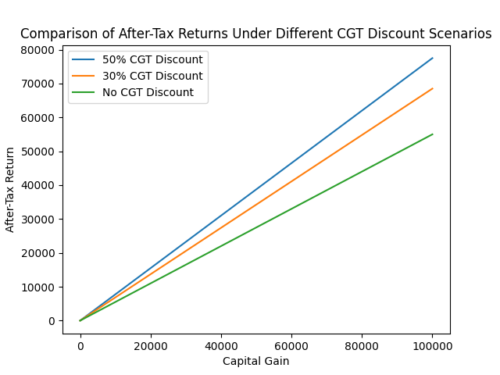
Comparison of after-tax investment returns under different CGT discount scenarios.
Strategic Implications for Property Investors
For property investors, the key takeaway is that uncertainty does not equal immediate risk. The absence of legislated change means that long-term strategies should not be altered based on speculation alone.
However, it would also be imprudent to ignore the direction of policy discussion. The increasing scrutiny of CGT suggests that some form of reform is plausible over the medium to long term.
Investors should focus on fundamentals such as asset quality, cash flow resilience, and long-term capital growth rather than attempting to time policy changes.
Should Investors Act Now?
One of the most common reactions to potential CGT reform is the urge to act immediately, often by selling assets to “lock in” current tax settings. This approach is rarely optimal.
Selling decisions should be driven by investment fundamentals, not tax speculation. Prematurely exiting an asset can trigger unnecessary tax liabilities and forgo future growth.
It is also important to note that many tax reforms historically include transitional provisions or grandfathering arrangements, meaning existing investments may not be affected in the same way as new ones.
What Investors Should Do Moving Forward
Rather than reacting to uncertainty, investors should adopt a structured and informed approach.
Portfolio diversification remains essential, particularly in an environment where tax settings may evolve. Structuring decisions, such as whether to hold assets personally or through other entities, should be reviewed with professional advice.
Long-term holding strategies continue to provide tax advantages under the current system, particularly through access to the CGT discount. Even in a reformed system, long-term investment is likely to remain a core principle.
The Bigger Picture: Tax Reform and Economic Policy
CGT reform does not exist in isolation. It is part of a broader conversation about tax efficiency, housing affordability, and economic equity.
Policymakers must balance competing objectives, including revenue generation, investment incentives, and social outcomes. This complexity explains why reform is often debated extensively but implemented cautiously.
Understanding this broader context allows investors to interpret policy discussions more accurately and avoid overreacting to short-term narratives.
Conclusion
The discussion around CGT reform is both significant and ongoing, but it is frequently misunderstood. While there are credible proposals and increasing political attention, there is currently no legislated change that fundamentally alters the existing system.
For investors, the most important distinction is between what is real and what is political. Acting on speculation rather than confirmed policy can undermine long-term investment outcomes.
A disciplined, informed, and strategic approach remains the most effective way to navigate uncertainty. CGT may evolve, but sound investment principles remain constant.
FAQ
- What is the current CGT discount in Australia? The current CGT discount allows individuals to reduce their capital gain by 50% if the asset has been held for more than 12 months .
- Are CGT changes already implemented? No, as of now, proposed changes remain under discussion and have not been legislated.
- Will CGT reform reduce property prices? Economic modelling suggests only a modest impact, with potential price reductions of around 1–2% .
- Who benefits most from the CGT discount? Higher-income earners receive a disproportionate share of the benefits, making it a key issue in inequality debates .
- Should investors sell before CGT changes? Not necessarily. Decisions should be based on investment fundamentals rather than speculation about future tax policy.
EXTERNAL LINKS:
- Capital Gains Tax Explained – What Every Aussie Investor Should Know
- Hot property: negative gearing and capital gains tax
- A capital gains tax discount is legitimate but how much?
- Explained: How capital gains tax hike could affect you
- CGT discount to cost $247bn in next decade
- PM leaves door open to capital gains tax reform
- Aussies dealt $250 billion blow as cost of controversial policy snowballs