
Australia’s rental market has become one of the most closely analysed segments of the housing sector, particularly as rents continue to rise across most capital cities. Public discussion often attributes these increases to migration alone, especially following the post-pandemic population surge. However, this explanation oversimplifies a far more complex system.
Rental price growth is ultimately shaped by the interaction between vacancy rates, housing supply constraints, population changes, and broader economic conditions. Among these, vacancy rates remain the most immediate and reliable indicator of rental pressure, while migration acts as an accelerant rather than the root cause.
Understanding how these forces work together provides a clearer and more accurate picture of what is truly driving rent increases in Australia.
Vacancy Rates: The Most Direct Driver of Rent Growth
Vacancy rates sit at the centre of rental market dynamics. They measure how many rental properties are available at any given time, and they directly influence pricing power.
In Australia, a vacancy rate below 2% is widely considered tight. When rates fall closer to 1%, competition increases sharply, often resulting in rapid rent growth. This has been evident across most capital cities, where rental availability has remained historically low.
Recent market analysis shows that vacancy rates have fallen well below long-term averages, with national levels sitting around half of pre-pandemic norms, highlighting the severity of supply constraints. This trend has been a key factor behind rent increases, as outlined in research showing how record-low vacancy rates are continuing to push rental prices higher across Australia.
When rental stock is limited, tenants are forced to compete for fewer properties, giving landlords greater pricing power.
Vacancy Rate and Rent Growth in Australia (2015-2024)
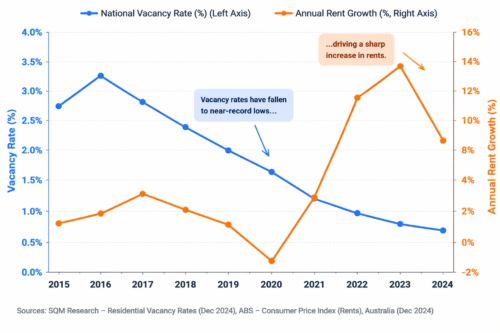
This chart shows the inverse relationship between vacancy rates and rent growth in Australia between 2015 and 2024. As national vacancy rates tightened, especially from 2020 onward, annual rent growth accelerated sharply, reinforcing the point that limited rental supply has been one of the strongest drivers of rent increases.
Migration: A Demand Shock, Not the Root Cause
Migration has played a visible role in increasing housing demand, particularly in major cities such as Sydney and Melbourne. Following the reopening of international borders, Australia experienced a significant increase in population inflows, placing additional pressure on rental markets.
However, migration alone does not automatically lead to rent increases. Its effect depends on the availability of housing at the time. When vacancy rates are already low, additional demand quickly translates into higher rents.
Data from the Australian Bureau of Statistics shows that population growth has been concentrated in urban areas, intensifying pressure in already tight markets. This is clearly demonstrated in the ABS analysis of recent rental market trends and how population changes are influencing rent movements, where rents have risen strongly since 2021 alongside increased demand.
Migration should therefore be viewed as a demand amplifier rather than the underlying cause.
Housing Supply: The Structural Constraint
The most significant factor behind sustained rent increases is the lack of housing supply. Australia has experienced a prolonged period where new housing construction has failed to keep pace with population growth.
Construction delays, rising material costs, and labour shortages have all contributed to slower delivery of new dwellings. Even when approvals increase, it can take years before properties are completed and available for rent.
This ongoing shortage has kept vacancy rates low and maintained upward pressure on rents. Market reporting continues to highlight that tight rental conditions persist because available listings remain below normal levels, reinforcing the structural imbalance. This has been observed in recent coverage showing how rental markets remain constrained despite some moderation in price growth.
Until supply improves, rental pressures are likely to remain.
Comparing the Key Drivers of Rent Increases
The interaction between these factors becomes clearer when viewed together:
|
Driver |
Immediate Impact on Rents | Long-Term Influence |
Role in the Market |
|
Vacancy Rates |
Very High | High |
Direct pricing pressure due to scarcity |
|
Migration |
Moderate | High |
Increases demand in key locations |
|
Housing Supply |
Low (short-term) | Very High |
Determines long-term market balance |
|
Interest Rates |
Moderate | Moderate |
Affects investor activity and development |
|
Wage Growth |
Low | Moderate |
Influences affordability limits |
This comparison reinforces a key point: vacancy rates determine how quickly rents rise, while supply determines how long those increases persist.
The Supply and Demand Feedback Loop
Australia’s rental market is currently shaped by a reinforcing cycle. Low vacancy rates push rents higher, but supply remains slow to respond due to construction constraints and financing challenges.
At the same time, higher interest rates have reduced investor participation, limiting the addition of new rental stock. This prolongs tight market conditions and sustains upward pressure on rents.
For investors, focusing on these structural factors is far more valuable than reacting to short-term headlines. Those looking to better understand how these conditions affect their portfolio can benefit from speaking with a property investment advisor who can provide tailored insights.
Regional and City-Level Differences
While capital cities dominate headlines, regional markets have also experienced rental pressure. Internal migration during the pandemic shifted demand toward lifestyle regions, tightening vacancy rates outside metropolitan areas.
Although some of this trend has eased, many regional markets still face limited housing supply, which continues to support elevated rents.
This highlights that rental pressures are not solely driven by international migration but also by domestic population shifts and local supply constraints.
Interest Rates and Investor Behaviour
Interest rates influence the rental market indirectly by affecting borrowing costs and development activity. Higher rates reduce the feasibility of new projects and can discourage investor participation.
Although some landlords attempt to pass on higher costs through rent increases, the ability to do so depends on market conditions. In tight markets, tenants have fewer alternatives, making rent increases more achievable.
More importantly, reduced development activity limits future supply, reinforcing existing shortages.
The Affordability Ceiling
Despite strong demand, rent increases are ultimately constrained by income levels. As rents rise, they take up a larger share of household income, forcing tenants to adjust.
This may involve moving to more affordable areas, sharing accommodation, or reducing discretionary spending. These adjustments can slow rental growth but do not resolve the underlying supply shortage.
Understanding the Bigger Picture
Rental trends are closely linked to broader housing market dynamics, including construction activity, lending conditions, and investor sentiment. Viewing these factors together provides a more complete understanding of where the market is heading.
For a broader perspective, you can explore Australia’s property market insights and investment strategies, which connect rental trends with wider housing conditions.
You may also find it useful to read our related article on why rental growth has remained resilient in Australia, which expands on the role of supply constraints in shaping the market.
Conclusion
The drivers of rent increases in Australia are often misunderstood. While migration is highly visible, it is not the primary cause of rising rents. Instead, vacancy rates provide the clearest signal of market pressure, reflecting the balance between supply and demand.
Housing supply constraints remain the underlying issue, limiting the market’s ability to respond to increased demand. Until supply improves, rental affordability challenges are likely to persist.
For investors, understanding these structural drivers is essential for making informed decisions in an increasingly complex market.
Frequently Asked Questions (FAQ)
- What is the biggest driver of rent increases in Australia? Low vacancy rates are the most immediate driver, as they indicate limited rental supply and increased competition.
- Does migration directly increase rents? Migration increases demand, but rents only rise significantly when housing supply cannot keep up.
- Why is rental supply limited? Construction delays, rising costs, and labour shortages have slowed the delivery of new housing.
- Will rents continue to rise? Rents may continue to increase if vacancy rates remain low, although affordability constraints may slow growth.
- What should investors focus on? Investors should focus on vacancy rates, supply pipelines, and local market conditions rather than broad national trends.