

Investing in Australian real estate has long been considered one of the most reliable ways to build wealth and achieve financial independence. From consistent capital appreciation to stable rental income, property has remained a cornerstone of Australia’s investment culture. As we move through 2025, several key factors have aligned to make this year an especially compelling time to enter or re-enter the market.
From market resilience to favorable lending conditions and surging rental demand, the current landscape offers a rare combination of stability and opportunity. Whether you are a first-time investor looking to build your portfolio or an experienced buyer seeking the next growth hotspot, the conditions in 2025 are difficult to ignore.
Market Resilience Amid Economic Shifts
Despite ongoing global economic challenges, the Australian property market continues to perform strongly. While many international markets have experienced volatility, Australia’s real estate sector has shown remarkable strength. Recent CoreLogic data indicates that national home values have increased by approximately 5 percent over the past year, with some regions outperforming even the most optimistic expectations.
This steady growth reflects not only the inherent resilience of the property market but also the deep structural factors that support it, such as strong population growth, limited housing supply, and a cultural preference for home ownership. Even with inflationary pressures and shifts in global interest rates, Australian real estate has remained a dependable investment option for both domestic and international buyers.
Historically, property has proven to be one of the few assets capable of weathering economic downturns. When other asset classes fluctuate, real estate often rebounds quickly as investors seek tangible, income-generating opportunities. The renewed confidence among buyers in 2025 reinforces Australia’s reputation as one of the world’s most stable property markets.
Favorable Interest Rates and Lending Conditions
Monetary policy continues to play a key role in shaping the investment environment. The Reserve Bank of Australia has maintained relatively low and stable interest rates compared to previous cycles, creating an accommodating borrowing climate for investors. This stability allows buyers to secure loans at competitive rates, improving cash flow and making investment properties more affordable.
Lending conditions have also become more flexible. Financial institutions are offering a wider range of mortgage products designed to suit different types of investors, including those purchasing through self-managed super funds. As a result, access to finance has improved significantly compared to the tighter credit environment seen only a few years ago.
Lower borrowing costs not only make it easier to enter the market but also enhance potential returns. Investors can use this environment to expand their portfolios or upgrade to higher-performing properties without taking on excessive financial risk. For many, 2025 represents an ideal moment to take advantage of these supportive lending conditions before any future tightening occurs.
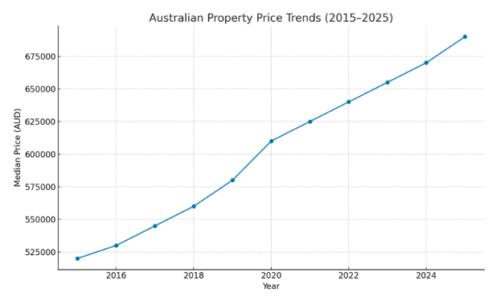
Graph: Australian Property Price Trends (2015-2025)
High Rental Demand and Yield Opportunities
The Australian rental market has entered a period of exceptional strength. Vacancy rates have fallen to record lows of around 1 percent nationwide, according to data from Domain and SQM Research. In many cities, renters are competing for limited housing, leading to substantial increases in weekly rents.
This surge in demand has produced strong rental yields for investors. In several capital cities, rental returns have risen between 8 and 10 percent year on year, providing a reliable income stream that complements long-term capital growth. Importantly, this trend is not confined to major urban centres. Regional areas are also benefiting from robust tenant demand, driven by lifestyle changes and the continued popularity of remote work.
The combination of low vacancies, increasing rents, and stable property values creates a powerful incentive for investors who want to balance steady income with capital appreciation. Those who purchase now are likely to see the benefits of strong rental performance alongside the potential for long-term value growth.
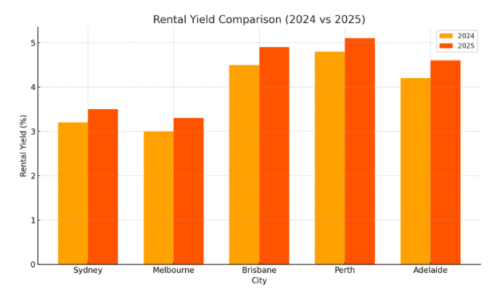
Chart: Rental Yield Comparison (2024 vs 2025)
Emerging Investment Hotspots
Beyond the traditional markets of Sydney and Melbourne, several new regions are emerging as strong investment prospects. Cities such as Brisbane, Perth, and Adelaide are attracting significant attention due to infrastructure investment, employment growth, and interstate migration.
- Brisbane continues to benefit from preparation for the 2032 Olympic Games, with billions of dollars being invested in transport, housing, and urban renewal projects. These developments are expected to drive sustained price growth over the next decade.
- Perth has experienced a major resurgence, supported by a strong resources sector and steady population inflows from the eastern states. Its relative affordability and high rental yields make it an attractive option for investors seeking solid returns.
- Adelaide and selected regional hubs in Queensland and New South Wales are also gaining popularity, offering lifestyle appeal alongside consistent rental demand and affordable entry points.
By identifying and investing in these markets early, investors can benefit from both near-term income growth and long-term capital appreciation. The key is to research local conditions carefully and align your property choices with the economic and demographic trends driving demand in each area.
The Broader Economic Context
Australia’s overall economic fundamentals remain strong. Population growth, driven by high levels of migration, is continuing to place pressure on housing supply across the country. This ongoing imbalance between supply and demand is a major factor supporting property prices.
At the same time, the federal and state governments are investing heavily in infrastructure, including transportation networks, renewable energy projects, and housing development. These initiatives are stimulating regional economies and improving connectivity, which in turn boosts the long-term value of surrounding property markets.
Inflation is showing signs of stabilising, and employment levels remain high. These positive indicators contribute to consumer confidence and encourage continued investment in housing. Together, these factors paint a favourable picture for the property market through 2025 and beyond.
Conclusion
The convergence of market resilience, favourable lending conditions, strong rental demand, and the rise of new investment hotspots makes 2025 one of the best times in recent memory to invest in Australian real estate. The market is showing consistent growth, while broader economic trends continue to support property as a stable and rewarding asset class.
For investors who act strategically and focus on well-researched locations, the potential for long-term wealth creation is significant.
Do not wait for the perfect moment to invest. Instead, take advantage of today’s conditions and position yourself for success. Set up a call with us to explore your next property opportunity and start building a portfolio that will grow with you over the next decade.
__________________________________________________________________________
External Link: