

You’re not alone if you’re curious about what happens in Australia following a real estate boom. Once the headlines shift from record prices to discussions of cooling conditions and risks, many investors experience the same mixture of relief and worry. Fortunately, a boom is just one phase of the real estate cycle. For investors who are ready, knowledgeable, and patient, what comes next may be a time of true opportunity.
An important note before we continue. This article contains general information. It is not financial advice and does not consider your needs, goals, or financial circumstances. Before implementing any real estate strategy, always consult a qualified advisor or tax expert.
Where are we in the Australian property cycle now
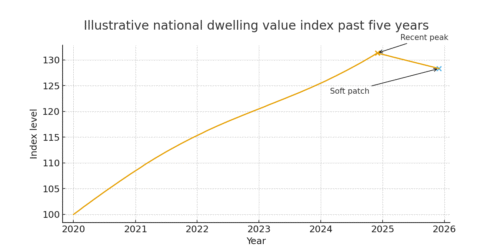
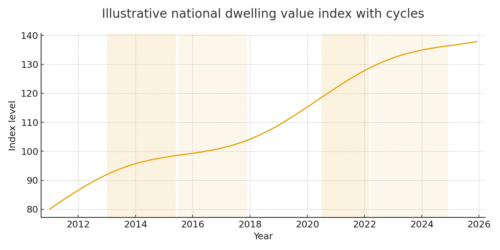
Property prices in Australia have moved through repeated cycles of strong growth, slower growth, flat periods, and occasional modest declines. Recent data suggests that the latest surge in values is giving way to a more balanced phase rather than a simple collapse.
For instance, the national values posted a brief decline on a month-to-month basis at the close of 2024, down for the first time in nearly two years, before stabilizing again at the start of 2025.
Meanwhile, the aggregate current value of residential real estate has continued to climb over the past year, with one recent estimate placing the market at around 11.8 trillion dollars, up more than 600 billion dollars over twelve months.
The important point, however, is that the market can move from a surge to a softer patch without necessarily developing into a severe national crash. The fundamental forces that typically shift a boom into a cooler phase include:
- Changes in interest rates and borrowing capacity
- How tight or loose bank credit standards are
- How many new dwellings come to the market within a short period?
- Local employment and population trends
Once you understand these drivers, you’ll be able to read the cycle with more confidence, rather than making purely emotional decisions.
What history tells us after past Australian property booms
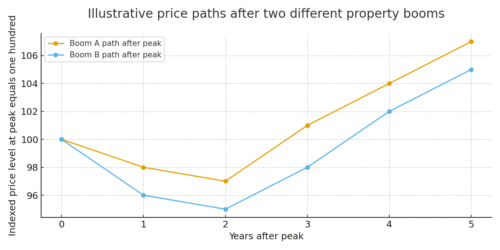
While looking back at earlier booms does not provide a certain prediction of the future, it does offer helpful patterns. In research on past housing cycles in Australia and overseas, the nature of the boom often sets the scene for the correction. Periods of very rapid and extended price growth are generally followed by more noticeable slowdowns, while more moderate booms often transition into flat periods rather than sharp falls.
Local research into recent Australian booms paints a similar picture. National prices don’t always collapse after a peak. In many cases we see:
- A short period of slight national price declines
- Several years of flat nominal prices while incomes catch up
- Large discrepancies between cities and regions, including some that are still expanding and others that are pulling back.
Investors should note that the national headlines portray averages; however, each suburb’s property types and price points can behave very differently. This also indicates that there are generally periods following real estate booms where emotional sellers and anxious buyers produce a mispricing that disciplined investors can take advantage of.
Where smart investors look for opportunity after a boom
So, what’s left when the party’s over?
For starters, the whole mood shifts. In a hot market, every decent property gets snapped up fast. Buyers settle for odd layouts or less-than-ideal spots because they just want in. Once things cool off, the tide turns. Suddenly, serious buyers get picky again. Homes stay listed longer. Sellers start listening to offers, whether it’s about price, settlement terms, or both.
That’s when you get to focus on the basics—not just the FOMO. Here’s what really counts:
- Locations where people actually want to live, close to jobs and good infrastructure.
- Homes that appeal to owner-occupiers. Think good light, smart floor plans, parking—stuff that never goes out of style.
- Places you can improve, either by renovating or just managing better.
You’ll probably notice yields start to look better compared to borrowing costs. It doesn’t happen overnight, but as prices stop soaring, rents have a chance to catch up. If you’ve set up your loans with some wiggle room, your cash flow gets healthier.
Analysts watching the Australian market see this as a shift toward steady, measured growth, not the wild swings we saw in earlier years.
Honestly, this kind of market suits investors with a plan. The days of the quick-flip speculator are fading.
But don’t kid yourself—risks are still there
A cooling market brings its own set of traps.
Leverage is a big one. If you borrowed heavily when prices peaked, you’re exposed if interest rates climb or your income takes a hit. Missed rent or surprise repairs feel a lot worse when there’s no buffer.
Then there’s the classic mistake: confusing a cheap property with a good one. Some places are discounted for a reason—bad location, awkward layout, or just not much long-term demand. The discount won’t fix those problems.
And don’t forget about policy and lending risk. Changes to tax, tenancy laws, or bank rules can hit your cash flow or borrowing power. Keep up with reliable news and check official sites like ASIC’s Moneysmart to avoid nasty surprises.
So, what should you actually do?
- Check your financial buffer for loan payments and repairs.
- Stress-test your portfolio—imagine a vacancy, or rates going up. Could you handle it?
- Talk to your accountant or, if it makes sense, a licensed adviser before you make any big moves.
A simple plan for your next step
If you’re holding property after a boom, or thinking about buying now, keep it simple.
First, get clear on where you stand. List your properties, how much you owe, your interest rates, and what your cash flow looks like after tax. Note how much of your income relies on rent. This gives you a real sense of your risk.
Next, set your goal for the next few years. Want to pay down debt, boost cash flow, upgrade your portfolio, or add one solid property? Be specific.
Then, write down your buying criteria. City or region, property type, price range, minimum yield, must-have features—get it all on paper. Clear criteria stop you from chasing whatever looks shiny online.
Finally, build a small team. That might be your accountant, a broker, maybe a buyer’s agent or planner who knows property. Make sure anyone giving you financial advice is licensed and knows their stuff—ASIC lays out the standards, so double-check their credentials.
The quiet side of property cycles
Booms are loud and exciting, but the quieter phase after is where smart investors quietly build wealth. History shows the Australian market rarely crashes outright after a boom. Usually, prices flatten out or grow slowly. Within that, some areas will struggle, while others quietly set up for the next round of gains.
If you know where we are in the cycle, focus on quality, protect your buffers, and get the right advice, you’ll handle the post-boom years with confidence. Let this be a jumping-off point, not the final word. In the end, your goals, risk tolerance, and timeline matter more than any headline.
___________________________________________________________________________
External Links: